
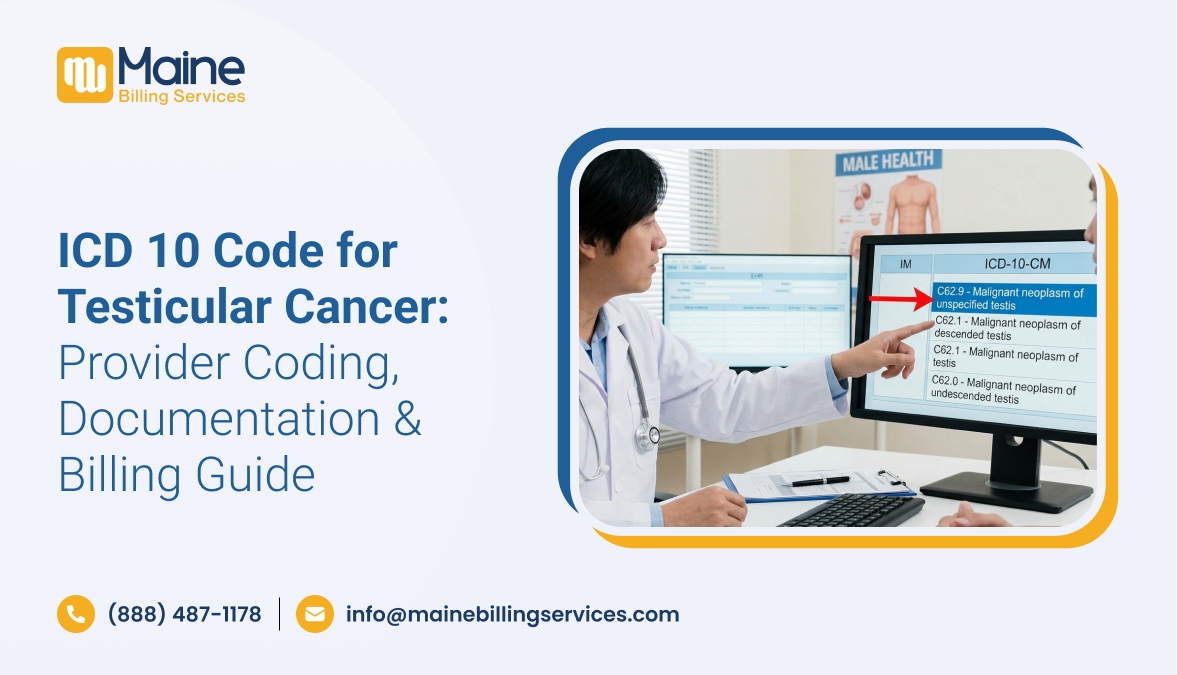
Testicular cancer coding requires more than identifying that a patient has a malignant neoplasm. Providers and billing teams must connect the documented diagnosis with the correct anatomical site, laterality, testicular position, and clinical circumstances. Accurate diagnosis coding helps support medical necessity, reduces claim issues, and gives payers a clearer picture of the patient’s condition.
Testicular Cancer ICD 10 Code falls under a category C62 for the malignant tumor of a testis. But C62 is a category not a billable item. More specific ICD-10-CM codes include whether the diseased testis is descended or undescended and, if applicable, whether the disorder involves the right or left testis.
The fundamental goal for physicians, urologists, oncologists and the medical billing teams should be simple – document the diagnosis more clearly, select the more specific supported code, and ensure the diagnosis is appropriately reflected throughout the claim.
What Is the ICD 10 Code for Testicular Cancer?
The primary ICD-10-CM classification for testicular cancer is C62 – malignant neoplasm of testis. Malignant neoplasms of the testis are included in this category. More detailed codes are given based on whether the testis is descended, undescended or unspecified.
Providers should not automatically bill C62 when a more precise billable code is available by the medical record. Providers should verify the applicable code set for the date of service using the official CDC ICD-10-CM files. The current ICD-10-CM includes codes for undescended testis, descended testis and testis of unspecified position.
Common Testicular Cancer ICD 10 Codes
| ICD-10-CM Code | Description |
| C62.00 | Malignant neoplasm of unspecified undescended testis |
| C62.01 | Malignant neoplasm of undescended right testis |
| C62.02 | Malignant neoplasm of undescended left testis |
| C62.10 | Malignant neoplasm of unspecified descended testis |
| C62.11 | Malignant neoplasm of descended right testis |
| C62.12 | Malignant neoplasm of descended left testis |
| C62.90 | Malignant neoplasm of unspecified testis, unspecified whether descended or undescended |
| C62.91 | Malignant neoplasm of right testis, unspecified whether descended or undescended |
| C62.92 | Malignant neoplasm of left testis, unspecified whether descended or undescended |
The codes are based on the FY2026 ICD-10-CM framework. C62 is a non-billable code. Providers and programmers are to use the most specific billable code that is supported by the documentation.
C62 is a category. Verify the complete billable ICD-10-CM code before claim submission.
ICD-10-CM is updated periodically, therefore practices should check the code set applicable to the date of service before submitting claims. The ICD-10-CM files and annual releases for diagnosis coding in the United States are identified by the CDC.
How Providers Should Approach Testicular Cancer Coding
Accurate testicular cancer diagnosis coding begins with the provider’s documentation. Coders should not assume anatomical details that are not documented in the medical record.
When documenting a confirmed testicular malignancy, providers should make the diagnosis as specific as clinically supported. Important details can include:
- Confirmed malignant neoplasm of the testis
- Right or left testis
- Descended or undescended testis
- Relevant pathology findings
- Primary tumor site
- Current disease status when clinically relevant
- Treatment or follow-up being provided
- Relevant metastatic disease when documented
- History of malignancy when the cancer is no longer active
The diagnosis recorded on the claim should be supported by the medical record. Good documentation provides a solid basis for the coders to select the correct ICD 10 code for testicular cancer instead of making assumptions or relying on incomplete clinical material.
Why Specificity Matters in Testicular Cancer ICD 10 Coding
A common coding problem occurs when a provider documents “testicular cancer” without enough anatomical detail for the coding team to determine the most specific available code.
For example, the ICD-10-CM classification separates malignant neoplasms of descended and undescended testis. It also provides laterality-specific codes in several categories.
If the documentation establishes that the malignancy involves the right descended testis, the coder has information to select a more specific code than an unspecified testis diagnosis.
On the other hand, coders should not manufacture specificity. If the medical record does not establish whether the testis is descended or undescended, the appropriate unspecified option may be necessary.
This distinction is important for both testicular cancer coding and claim accuracy. The objective is not to select the most detailed code at any cost. The objective is to select the most specific code that the documentation actually supports.
Documentation Tips for Providers
Strong documentation can make the coding and billing process much more efficient. Providers treating patients with testicular malignancies should consider including the following information when applicable:
Identify the Affected Testis
Document whether the cancer affects the right or left testis. Laterality can affect the code selection when the ICD-10-CM classification provides laterality-specific options.
Document Testicular Position
If applicable to the diagnosis, state whether the afflicted testis is descended or undescended. The ICD-10-CM classification has distinct code categories for various conditions.
Document the Confirmed Diagnosis
Differentiate a definitive cancer from a suspected lesion, mass or aberrant imaging finding. The diagnosis should be based on the provider’s clinical judgment and supporting evidence available.
Include Relevant Pathology
The pathology report can have important information regarding the tumor. Providers should ensure that the proper results are included in the medical record and diagnosis documentation when clinically appropriate.
Document Metastatic Disease Separately When Applicable
If the patient has documented secondary malignant neoplasms, those conditions may require additional diagnosis coding according to the applicable ICD-10-CM guidelines. The primary testicular malignancy should not be used as a substitute for documenting a separately established metastatic site.
Common Testicular Cancer Coding Errors
Even when a provider has clearly diagnosed cancer, billing problems can occur when documentation and coding workflows do not align.
1. Using C62 Instead of a Billable Code
C62 identifies the malignant neoplasm of testis category, but it is not itself a billable diagnosis code. A more specific code from the C62 category should be selected when supported.
2. Ignoring Laterality
When the documentation identifies the right or left testis and a laterality-specific code is available, failing to capture that information can reduce coding specificity.
3. Assuming Testicular Position
A coder should not assume that the affected testis is descended or undescended simply because one option appears more common clinically. The medical record should support the selection.
4. Coding a Suspected Condition as Confirmed Cancer
A testicular mass, abnormal ultrasound, or elevated laboratory result does not automatically establish a confirmed malignant neoplasm. Providers should document the diagnosis according to the clinical findings and diagnostic stage of the patient’s care.
5. Using an Outdated Code Set
ICD-10-CM is updated over time. The CDC publishes current files and release information, so practices should confirm that their coding resources correspond to the date of service.
6. Poor Diagnosis-to-Procedure Alignment
The diagnosis code must support the medical necessity of the treatment you are billing If the diagnosis, documentation and procedure coding do not present a cohesive clinical story, the claim may need further investigation.
Testicular Cancer Billing: What Providers Should Know
Accurate diagnosis coding is only one part of the revenue cycle. Testicular cancer billing can involve consultations, diagnostic services, surgery, pathology, imaging, oncology treatment, follow-up care, and other services depending on the patient’s treatment plan.
Each service must be reported according to applicable coding regulations and payer requirements. Providers should additionally address eligibility verification, permission requirements, claim filing, paperwork and follow-up.
For practices that process a high volume of oncology or urology claims, outsourcing some of the administrative responsibilities might ease the burden on clinical staff.
Maine Billing Services provides medical billing services in Maine including patient registration, insurance verification, prior authorization, charge input, claim filing, rejection management and payment follow-up.
The billing workflow should begin before the claim reaches the payer. Eligibility and authorization checks can identify potential problems early, while accurate charge capture and coding help create cleaner claims.
How Medical Coding Supports Cancer Billing
Medical coding connects the provider’s clinical documentation with the diagnosis and procedure information submitted to the payer.
For oncology and urology practices, this can become particularly important when patients receive multiple services across different stages of diagnosis and treatment.
A professional medical coding services workflow should review documentation carefully and confirm that the diagnosis codes accurately reflect the provider’s assessment.
Maine Billing Services states that its coding team uses ICD-10, CPT, and HCPCS coding as part of its revenue cycle workflow. Its billing process also includes documentation review and claim scrubbing before electronic submission.
For providers, the practical benefit is better alignment between clinical documentation, coding, billing, and payer requirements.
Testicular Cancer Claims and Denial Prevention
Cancer-related claims can become complicated when documentation is incomplete, coding is inconsistent, eligibility information is inaccurate, or payer-specific requirements are overlooked.
Common claim problems can include:
- Incorrect or incomplete diagnosis coding
- Missing clinical documentation
- Eligibility problems
- Authorization issues
- Coding inconsistencies
- Incorrect patient information
- Payer-specific claim requirements
- Medical necessity questions
- Untimely claim follow-up
A proactive approach is generally more effective than waiting until a large number of claims have been denied.
Maine Billing Services’ denial management services include denial analysis, root-cause determination, claim adjustment, resubmission, appeals and reporting.
Denial pattern reviews can help oncology and urology clinicians determine whether repeat problems are due to documentation, eligibility, authorization, coding or payer-specific criteria.
Documentation and Prior Authorization
Some cancer-related services may require prior authorization depending on the payer, plan, service, and clinical circumstances. Practices should verify requirements before providing services whenever applicable.
A missed authorization can create significant reimbursement problems. Providers and billing teams should establish a workflow that checks authorization requirements during scheduling or before the service is performed.
For additional information about situations involving authorization after a service has already been provided, see Maine Billing Services’ guide on retrospective authorization in medical billing.
The broader lesson is important for testicular cancer billing: authorization should be treated as part of the revenue cycle rather than as an isolated administrative task.
Who Can Benefit From Specialized Cancer Billing Support?
Testicular cancer patients may receive care from several types of providers. Depending on the clinical setting, billing requirements can involve urology practices, oncology groups, surgical practices, hospitals, pathology providers, imaging centers, and multidisciplinary clinics.
Providers may benefit from specialized oncology medical billing services when internal staff are struggling with:
- High claim volumes
- Complex payer requirements
- Coding workload
- Denial follow-up
- Prior authorization
- A/R management
- Claim reconciliation
- Documentation-related billing issues
Maine Billing Services offers billing services for chemotherapy, radiation therapy and medications, and a number of other specialties including oncology.
The company’s medical specialties billing services page also says it provides specialty-specific revenue cycle solutions to health practices in Maine.
Improving the Testicular Cancer Billing Workflow
Key focus: accurate documentation, specific diagnosis coding, payer requirements, clean claims, and timely follow-up.
A practical procedure keeps providers and billing teams consistent from the first appointment to final payout.
Step 1: Verify Patient Information
Verify a demographics, insurance eligibility and the payer information prior to services is being rendered.
Step 2: Review Provider Documentation
The clinical documentation shall be clearly specified that the diagnosis and a necessary anatomical fact.
Step 3: Assign the Appropriate ICD-10-CM Code
Based on the documentation, select a most specific ICD 10 code for a testicular cancer from the current code set.
Step 4: Review Procedure and Diagnosis Relationships
Confirm that diagnosis codes appropriately support the services being reported.
Step 5: Check Payer Requirements
Verify authorization, referral, documentation, and other payer-specific requirements when applicable.
Step 6: Scrub and Submit the Claim
Review the claim for missing or inconsistent information before electronic submission.
Step 7: Monitor the Claim
Track the claim through adjudication and investigate rejections or delayed payments promptly.
Step 8: Analyze Denials
When a claim is denied, identify the root cause rather than simply correcting the individual claim. Recurring errors may indicate a workflow problem.
For practices interested in improving their overall RCM process, the QW Modifier in Medical Billing guide on Maine Billing Services provides another example of how coding details and payer requirements can affect claim processing.
Why Providers Should Prioritize Coding Accuracy
Accurate coding is not simply a billing department responsibility. Provider documentation forms the foundation of the entire coding process.
Providers and coding professionals should also follow the CMS ICD-10-CM Official Guidelines for Coding and Reporting when assigning and reporting diagnosis codes.
When doctors write the diagnosis clearly, coders have better information to pick the right ICD-10-CM code. Where the coding is a true reflection of the material, billing teams can file claims with more robust clinical evidence.
This connection is particularly critical in cancer care as patients may receive a multitude of services from different doctors during diagnosis, treatment and follow up.
A consistent documentation and coding workflow can help practices identify problems before they become repeated claim issues.
Final Thoughts on the ICD 10 Code for Testicular Cancer
ICD 10 Code for Testicular Cancer is C62. Providers need to be aware that C62 is a non-billable code and that there are more specific ICD-10-CM codes available. The accurate classification is contingent on facts reported in the medical record such as whether the testis is descended or undescended and if relevant, laterality.
For providers, accurate testicular cancer coding starts with precise clinical documentation. Billing teams then need to translate that documentation into the appropriate diagnosis coding, connect diagnoses with the services performed, verify payer requirements, and monitor claims through reimbursement.
When coding, billing, and denial management become difficult to manage internally, specialized oncology medical billing services can provide additional administrative support. Maine Billing Services offers revenue cycle solutions for healthcare providers, including medical billing, coding support, claim submission, and denial management.
For practices looking to strengthen their revenue cycle, you can explore the Best Maine Billing Services to learn more about its billing and coding solutions for healthcare providers.
Important Coding Note
ICD-10-CM codes are updated, altered, or replaced. Always validate the code for the date of service using the current approved ICD-10-CM resources by providers and coding professionals. The CDC publishes the current ICD-10-CM files and annual releases for U.S. diagnosis coding.
Frequently Asked Questions
What is the ICD 10 code for testicular cancer?
The ICD-10-CM category for testicular cancer is C62, which represents malignant neoplasm of the testis. More specific billable codes within the C62 category identify factors such as laterality and whether the testis is descended or undescended.
What is the ICD 10 code for malignant neoplasm of the right testis?
The correct code depends on the right testis has descended or not. E.g., a malignant neoplasm of the descended right testis is C62.11 whereas a malignant neoplasm of undescended right testis is the C62.01 Providers should document the anatomical detail that supports a specific code.
Why is provider documentation important for testicular cancer coding?
This provider documentation allows coders to select the ICD-10-CM code that is most particular that is supported by the medical record. Information such as impacted testis, laterality, testicular location, verified diagnosis and related clinical findings can help reduce coding accuracy and claim difficulties.
What are common testicular cancer coding errors?
Common errors include utilizing the C62 category instead of a billable code, omitting laterality, incorrectly assuming descended/undescended testis, classifying suspected cancer as confirmed malignancy, and using an obsolete ICD-10-CM code set.
Can oncology medical billing services help with testicular cancer claims?
Yes. Oncology medical billing services can support practices with coding, claim submission, eligibility verification, authorization, denial management, payment posting, and accounts receivable follow-up. These services can help providers manage administrative billing tasks more efficiently.
How can providers reduce testicular cancer billing and coding errors?
Clear documentation of the diagnosis and anatomical characteristics, use of the current ICD-10-CM code set, review of diagnosis-to-procedure connections, verification of payer requirements, and engaging with skilled medical coding and billing professionals where necessary can help providers reduce errors.