
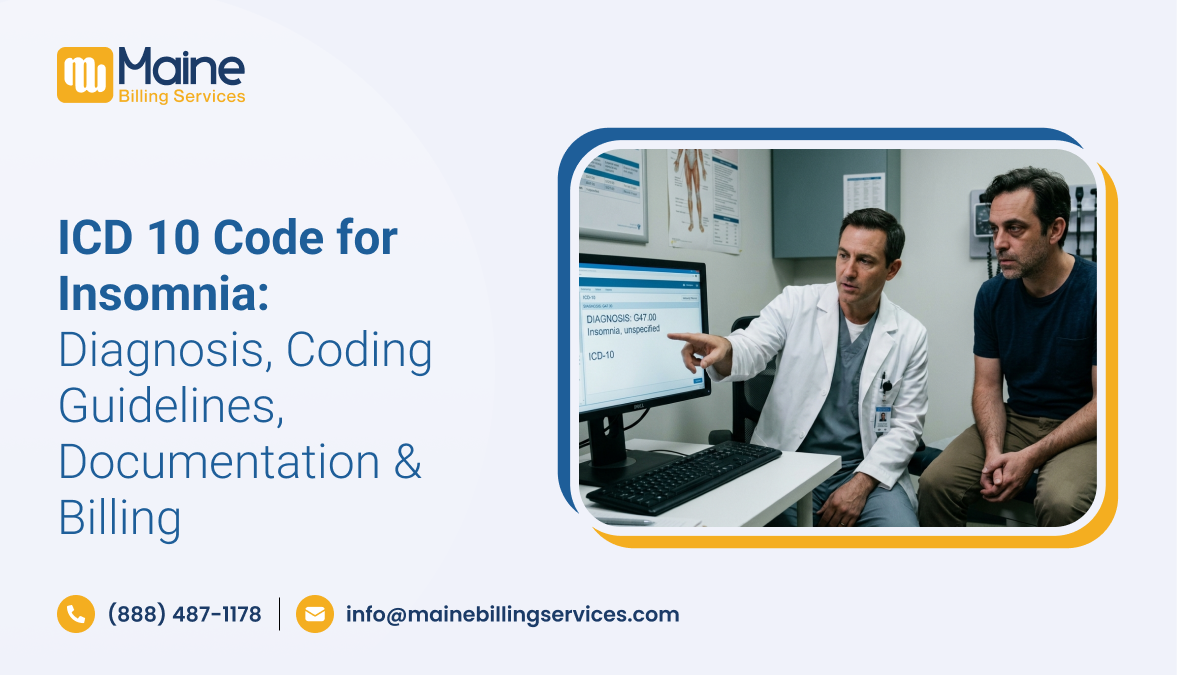
insomnia is a common sleep complaint, but selecting the correct diagnosis code can be more complicated than simply assigning an unspecified code. The appropriate ICD 10 code for insomnia depends on the diagnosis documented by the provider, the underlying cause, and the applicable ICD-10-CM coding guidelines.
For additional clinical information about insomnia, symptoms, diagnosis, and management, providers can refer to the National Heart, Lung, and Blood Institute (NHLBI) resources on insomnia.
Insomnia diagnoses help your healthcare practice with medical necessity, submitting your claim, and reimbursement to have accurate and consistent medical records. Your coding teams need to tell the difference between other types of loss of sleep and a mental disorder or medical condition.
This article describes the most common insomnia ICD-10-CM codes, documentation requirements, code selection, billing considerations, and common mistakes you will want to avoid on your claim.
What Is the ICD 10 Code for Insomnia?
Diagnostic Framework
Key Categories: G47 vs. F51 Insomnia Classifications
Quick classification matrix for precise claim submission
G47 Series
Organic & Physical Conditions
Assigned when sleep disruption stems from documented physiological, neurological, or underlying medical etiologies.
- G47.00: General / Unspecified Insomnia
- G47.01: Secondary to known medical condition
- G47.09: Other specified organic sleep disorders
F51 Series
Non-Organic & Behavioral Origin
Utilized when sleep disturbances are primary, psychological, stress-induced, or not tied to physical illness.
- F51.01: Primary Insomnia (non-organic)
- F51.02: Adjustment / Stress-related sleep loss
- F51.05: Associated with mental health conditions
You won’t find an individual code for each of the five types of insomnia. While the FY2026 ICD-10-CM version has several relevant codes (such as G47.00, G47.01, and G47.09), the other several diagnoses for insomnia are “F51 Insomnia not due to a substance or known physiological condition.”
Coding teams should verify the applicable code and current guidelines using the CMS ICD-10 code sets before submitting claims.
The respondent should choose the relevant ICD 10 insomnia classification code based on the documentation provided by the service provider, not simply on what a patient explains to them.
For instance, a code of G47.00 is used for unspecified insomnia, while a code of G47.01 is used for insomnia caused by a medical condition. Additionally, codes G47.01 – G47.09 are used to further specify the following types of insomnia: primary, adjustment, psychophysiological, or other mental disorder.
Common ICD 10 Codes for Insomnia
| ICD-10-CM Code | Description |
| G47.00 | Insomnia, unspecified |
| G47.01 | Insomnia due to medical condition |
| G47.09 | Other insomnia |
| F51.01 | Primary insomnia |
| F51.02 | Adjustment insomnia |
| F51.03 | Paradoxical insomnia |
| F51.04 | Psychophysiological insomnia |
| F51.05 | Insomnia due to other mental disorder |
| F51.09 | Other insomnia not due to a substance or known physiological condition |
CMS lists these insomnia diagnoses in its ICD-10-CM materials. The classification also contains exclusions and coding instructions, so the final code should be based on the complete clinical documentation and current coding guidelines.
How to Choose the Correct Insomnia Diagnosis Code
5-Step Code Selection Workflow
Follow this clinical protocol to eliminate claim rejections and ensure medical necessity.
Insomnia diagnosis code selection isn’t just based on a key word search in a provider note. Coding teams should analyze the clinical documentation and identify specifically what the provider is diagnosing.
Review the Provider’s Diagnosis
Begin with the provider’s evaluation and notations about the diagnosis. The patient may give a history of problems falling asleep, waking frequently in the night, or awakening early in the morning, but without the symptoms the diagnosis code may not be appropriate.
The medical record should support the diagnosis reported on the claim. Coders should avoid selecting a code simply because it appears to describe one symptom mentioned in the note.
Identify the Type or Cause of Insomnia
Next, determine whether the provider documented a specific type or cause.
For example, the record could specify the history of insomnia as resulting from a medical condition, adjustment insomnia, psychophysiological insomnia, or insomnia associated with other mental disorder. It does make a difference because those diagnoses may correspond to different codes in the ICD-10-CM.
Check the Current ICD-10-CM Code Set
ICD-10-CM codes and guidelines may be revised from time to time. Prior to billing, coding teams should verify the insomnia ICD-10-CM code chosen is valid for the date of service.
Claim denials, incorrect recordkeeping, and avoidable billing adjustments are possible if an outdated code is used.
Match the Code to the Documentation
The selected diagnosis code should be supported by the provider’s documentation. If the note does not establish the type, cause, or relationship of the insomnia, the coder should not create clinical specificity that the provider did not document.
Review Coding Instructions
Some insomnia codes have additional instructions or exclusions. For example, G47.01 identifies insomnia due to a medical condition and requires attention to the associated condition. F51.05 identifies insomnia due to another mental disorder and includes an instruction to code the associated mental disorder.
A careful review of the tabular instructions helps prevent inappropriate code selection.
Insomnia Documentation Requirements
Proper documentation is critical for good insomnia medical coding. Providers should include a diagnosis statement and any clinical information that helps substantiate the diagnosis for the condition they are treating.
Depending on the encounter, documentation may include:
- The provider’s specific insomnia diagnosis
- Relevant symptoms and clinical findings
- Duration or pattern when clinically documented
- Associated medical or mental health conditions
- Relevant medications or substances when applicable
- Assessment and treatment plan
- Medical necessity for the services provided
- Follow-up or response to treatment when relevant
Documentation should support the diagnosis without adding information that was not established by the provider.
Practices can also review their documentation processes through resources such as clinical documentation guidance to identify gaps that may affect coding and claims.
Provider Charting & Audit Readiness Checklist
Essential Elements for Supporting Specificity
Specific vs. Unspecified Insomnia Codes
An unspecified code may be appropriate when the documentation does not establish a more specific diagnosis. However, it should not automatically be used for every insomnia encounter.
For example, a G47.00 also characterizes unspecified insomnia. G47.01 should be used if the provider explicitly states that the patient experiences insomnia as a result of a specific medical condition and the notes support the connection. Diagnosis within the F51 category could also result in a different code.
The goal is to choose not the most specific code but rather the most appropriate code, which is justified by the documentation submitted by the provider and the requirements specified in ICD-10-CM guidelines.
F51.01 vs. G47.00: Which Insomnia Code Should Be Used?
F51.01 and G47.00 should not be treated as interchangeable codes. It is used for primary insomnia and requires documentation showing that the provider diagnosed the patient with primary insomnia. G47.00, on the other hand, is used for insomnia that is documented without a more specific type being identified. For your first code, G47.00, it just notes insomnia, unspecified.
F51 also categorizes other disorders based on the following definitions: Adjustment insomnia, paradoxical insomnia, psychophysiological insomnia, or insomnia as a result of another mental disorder.
Coding teams need to examine the diagnosis, the documentation, and the tabular guidelines prior to code assignment because this difference can impact the precision of the claim.
ICD-10-CM vs. CPT Codes for Insomnia
ICD-10-CM and CPT codes serve different purposes on a medical claim.
The patient’s diagnosis or condition is summarized by ICD-10-CM codes. CPT codes generally are a description of the medical service or procedure that the provider does.
A diagnostic code for an insomnia encounter provides the reason the service was provided; the CPT code is a representation of the service that is the basis for billing. The two should be clinically and administratively consistent.
For practices that handle a high volume of claims, professional medical coding services can help review ICD-10-CM and CPT code selection before claims are submitted.
Insomnia Billing and Claims Workflow
Accurate coding is only one part of successful insomnia billing. Practices also need a consistent workflow from patient registration through payment collection.
Verify Insurance Benefits
Patient Eligibility / Coverage / Benefits / Limitations / Authorizations Prior to Treatment Confirm eligibility, coverage, benefits, limitations and any required authorizations to make sure there are no coverage issues for the patient and the procedure.
Review Documentation and Codes
Examine the medical record, diagnosis, procedure codes, modifiers, and documentation. Document the diagnosis to match the provider’s documented condition.
Submit Clean Claims
Patients, providers, diagnosis codes, procedure codes and other required information should all be correct in the claims. Claim edits and scrubbing can aid you in catching these types of mistaken information.
Monitor Claim Adjudication
After submission, track claim status and review payer responses. Rejections and denials should be identified promptly so corrections can be made within payer deadlines.
Follow Up on Unpaid Claims
Overdue or underpaid claims should be tracked in accounts receivable follow-up. The longer you wait to act, the harder it may become to collect-especially as claims near timely filing or appeal deadlines.
End-to-End Insomnia Claim Cycle & Prevention Points
Protecting practice revenue across each stage of the claims cycle
Common Insomnia Coding and Billing Errors
Even small coding or documentation problems can create unnecessary billing issues.
Using G47.00 Automatically
Not every insomnia diagnosis should be reported as unspecified insomnia. Coders should review the documentation for a more specific supported diagnosis.
Choosing the Wrong Insomnia Category
Confusing G47 codes with F51 codes can result in inaccurate diagnosis reporting. The provider’s documented diagnosis and applicable classification should guide the selection.
Coding From Symptoms Instead of the Diagnosis
Difficulty sleeping is a symptom. It does not necessarily establish the specific insomnia diagnosis without appropriate provider documentation.
Documentation Does Not Support the Code
A claim may be denied when the documentation does not support the diagnosis reported. Missing information about the cause or clinical relationship can make code selection difficult.
Diagnosis and Procedure Codes Do Not Align
The diagnosis should reasonably support the service being billed. A mismatch can create medical necessity concerns or payer edits.
Ignoring Payer Requirements
Payers may have different documentation, authorization, claim submission, or coverage requirements. Coding teams should review applicable payer policies instead of relying only on general billing practices.
Practices experiencing recurring coding-related denials may also benefit from reviewing common medical coding errors and identifying patterns in their own claims.
How Accurate Insomnia Coding Supports Reimbursement
Accurate coding helps create a stronger connection between the patient’s documented condition and the service reported on the claim.
A consistent process can help practices:
- Reduce avoidable coding errors
- Support medical necessity
- Submit cleaner claims
- Reduce unnecessary rework
- Identify documentation gaps
- Improve claim follow-up
- Support accurate reimbursement
Accurate insomnia claims management should therefore be viewed as part of the complete revenue cycle rather than as a separate coding task.
When Practices May Need Insomnia Medical Billing Support
The provision of sleep services can be complex, with a variety of providers, diagnoses, procedures, payer mandates and documentation standards. Keeping track of all of those requirements can be a challenge as demand increases.
Insomnia medical billing services and generalized sleep disorder billing services are available if the practice is looking for assistance with coding, claim submission, eligibility verification, denial management, payment posting, and accounts receivable.
In addition to assisting with diagnosing, coding, claims submissions, denials management, and all other revenue cycle tasks, behavioral health providers who provide mental health services for insomnia and other illnesses would benefit from mental health billing services.
Maine Billing Services serves many specialties providing billing and coding services to behavioral and mental health practices, family medicine billing practice, internal medicine and other specialties.
Final Takeaway
The correct ICD 10 code for insomnia depends on the provider’s documented diagnosis and the applicable ICD-10-CM guidelines. Common codes include G47.00, G47.01, G47.09, and several F51 codes for specific forms of insomnia.
Do not report unspecified insomnia when documentation supports more specific diagnosis. Proper documentation, coding, claim editing and follow-up can prevent many billing errors that can occur.
For Maine practices that require supplemental resources, matching on target coding with superior medical billing services and revenue cycle management can care for insomnia claims all the way through from documentation to reimbursement.
Frequently Asked Questions
What is the ICD-10 code for insomnia?
There is no single code for every insomnia diagnosis. Common ICD-10-CM codes include G47.00 for unspecified insomnia, G47.01 for insomnia due to a medical condition, and G47.09 for other insomnia. Specific F51 codes may apply to other documented forms of insomnia.
What is the ICD-10 code for unspecified insomnia?
The ICD-10-CM code for unspecified insomnia is G47.00. It should be used when the provider documents insomnia but does not establish a more specific diagnosis supported by the applicable coding guidelines.
What is G47.01?
G47.01 represents insomnia due to a medical condition. The associated medical condition should also be considered according to the applicable coding instructions.
What is G47.09?
G47.09 represents other insomnia. It is used when the documented condition fits this category rather than unspecified insomnia or insomnia due to a medical condition.
What is the ICD-10 code for chronic insomnia?
According to the National Center for Health Statistics, “There is not one general ICD-10-CM code for chronic insomnia. All of the codes specify the type of provider diagnosis and the type of classification.” A provider’s description of insomnia as chronic is not enough for the coder to choose an ICD-10-CM code.
Is insomnia coded as G47 or F51?
It can be coded in either category depending on the documented diagnosis and applicable ICD-10-CM instructions. G47 includes insomnia codes such as G47.00, G47.01, and G47.09, while F51 includes specific insomnia diagnoses such as F51.01, F51.02, F51.04, and F51.05.
Can insomnia be coded with an underlying medical condition?
Yes. When the provider documents insomnia due to a medical condition, G47.01 may apply, with the associated condition coded according to the applicable instructions.
Does the insomnia diagnosis support insurance reimbursement?
Insomnia Diagnosis alone does not ensure reimbursement. Reimbursement is driven by medical necessity, documentation, coverage, coding, payer requirements, authorization and the service billed.
How can insomnia practices reduce billing errors?
Practices can minimize preventable errors by keeping accurate documentation, reviewing diagnosis and procedure codes, verifying eligibility and payer requirements, submitting clean claims, monitoring denials and following up on no collected claims in a timely manner.