
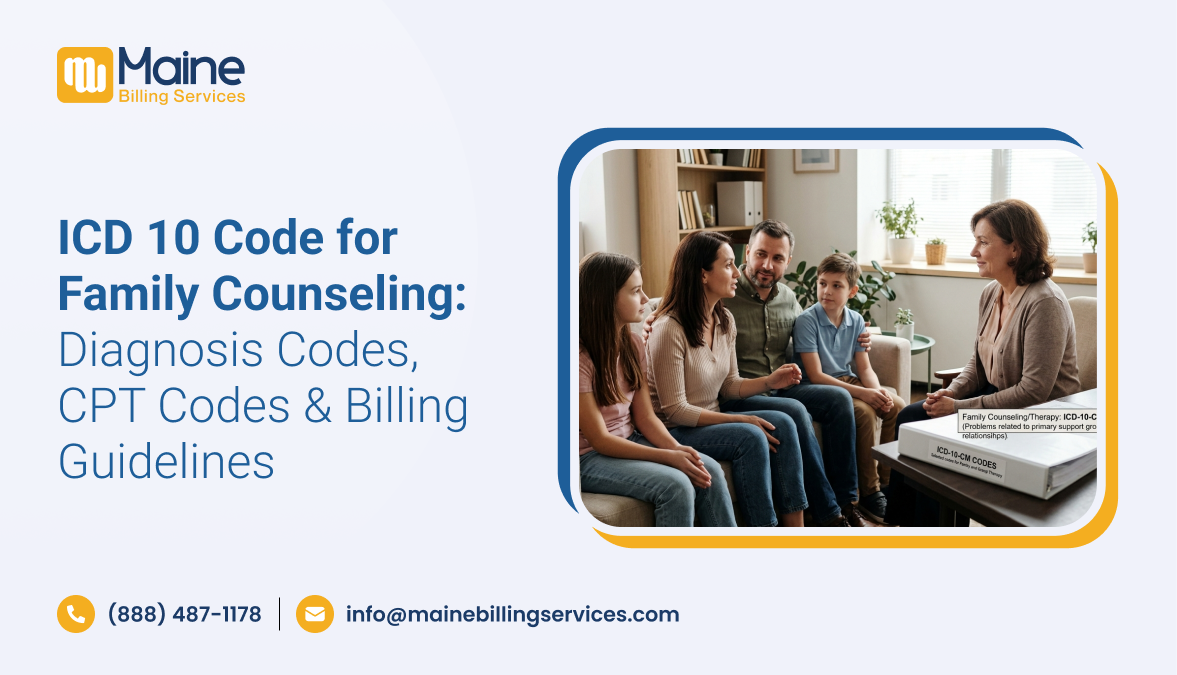
Family counseling can involve several members of a household and may address relationship difficulties, parent-child conflict, substance use, behavioral health conditions, or other family-related concerns. For providers and medical billers, correctly reporting these encounters requires understanding the difference between ICD-10 diagnosis codes and CPT family psychotherapy codes.
There is no one universal ICD 10 code for family therapy that covers all encounters. The appropriate diagnosis code to use will depend on the reason for the counseling and what the provider writes. The service itself may be billed with a CPT code such as 90846 or 90847 depending on whether or not the patient is present.
This is significant in behavioral health therapies since the correct claim must match the patient’s clinical status and the treatment that was actually provided.
Is There an ICD 10 Code for Family Counseling?
There is no ICD-10-CM diagnostic code for family counseling. Instead, the coder should choose the diagnosis or explanation for the contact that most closely describes the documented clinical condition.
The ICD-10-CM Official Guidelines contain Z-code categories for counseling for encounters for counseling and support with family or social difficulties. The supplier will code it as it should be coded based on what is documented.
Potentially relevant codes include:
| ICD-10-CM Code | General Use |
| Z71.89 | Other specified counseling |
| Z71.52 | Counseling for family member of drug abuser |
| Z63.0 | Problems in relationship with spouse or partner |
| Z62.820 | Parent-child conflict |
| Z63.8 | Other specified problems related to primary support group |
These codes should not be selected simply because a session involves multiple family members. The diagnosis must correspond to the reason for the encounter and the provider’s documentation.
Diagnosis Code vs. Service Code
ICD-10-CM and CPT codes answer different questions on a family counseling claim.
What is the clinical reason?
Identifies the documented diagnosis, circumstance, condition, or reason that explains the encounter.
Z63.0 | Z62.820 | Z71.52
What service was performed?
Identifies the professional service delivered during the family psychotherapy encounter.
90846 | 90847
For example, family psychotherapy for a patient who is treated for depression would usually be related with the patient’s documented mental health diagnosis rather than automatically giving a generic counseling Z code.
Common ICD 10 Codes Used for Family Counseling
The correct family counseling diagnosis code depends on the clinical circumstances. Several Z codes can become relevant when the primary reason for the encounter involves family or relationship circumstances.
Z71.89 — Other Specified Counseling
Z71.89 may apply to certain counseling encounters when the documentation supports counseling that does not have a more specific applicable diagnosis or counseling code.
It should not be used as a default code for every family therapy session. The coder should first review the documentation and determine whether a more specific diagnosis or reason for the encounter is available.
Z71.52 — Counseling for Family Member of Drug Abuser
Z71.52 is used specifically for counseling of a family member of an individual with drug abuse. This may be significant in some family counseling situations involving substance use.
However, the code should only be used when the documented circumstances meet its description. Providers should avoid selecting it merely because substance use is mentioned during a family therapy session.
Z63.0 — Relationship Problems with Spouse or Partner
Z63.0 may be relevant when the encounter involves documented problems in a relationship with a spouse or partner.
This can be particularly useful when the clinical focus is a relationship problem rather than treatment of an independently diagnosed psychiatric condition.
Z62.820 — Parent-Child Conflict
Z62.820 may apply when the documented reason for care involves parent-child conflict.
It is also important for the provider to provide a clear description of the nature of the dispute and its relevance to the meeting, as opposed to nonspecific references such as “family issues.”
Family Therapy CPT Codes: 90846 vs. 90847
The ICD-10-CM numbers describe the diagnosis or reason for the encounter. The CPT codes specify the service rendered.
Two important family therapy CPT codes are 90846 and 90847.
CPT 90846
90846 is used for family psychotherapy when the patient is not present. CMS describes this as family psychotherapy without the patient present, with a 50-minute service descriptor.
This code may apply when the therapist works with the patient’s family members without the patient participating in the session.
The medical record should establish the clinical purpose of the family psychotherapy and how the service relates to treatment.
CPT 90847
90847 is used for family psychotherapy when the patient is present. CMS identifies it as family psychotherapy with the patient present, also with a 50-minute service descriptor.
The distinction between 90846 and 90847 is therefore based largely on whether the patient is present during the family psychotherapy service.
90846 vs. 90847
| CPT Code | Patient Present? | Service |
| 90846 | No | Family psychotherapy without the patient present |
| 90847 | Yes | Family/conjoint psychotherapy with the patient present |
Providers should not choose between these codes simply based on whether family members participated. The patient’s presence and the actual service documented should be considered.
CMS also states that these codes represent family psychotherapy and should not be used for taking a family history or for ordinary evaluation and management counseling.
90846 or 90847?
The patient’s participation is an important part of distinguishing these two family psychotherapy codes.
Family psychotherapy provided without the patient participating in the session.
Family or conjoint psychotherapy provided with the patient participating in the encounter.
What Is the Difference Between ICD 10 and CPT Codes for Family Counseling?
One of the most popular areas for confusion is trying to swap an ICD-10 diagnosis code out for a CPT procedure code.
They serve different purposes:
ICD-10-CM: Explains the diagnosis, condition, symptom, circumstance, or reason for the encounter.
CPT: Describes the healthcare service provided.
For example, a provider might document a family therapy encounter about parent-child conflict. An appropriate ICD-10-CM code may reflect the documented family situation, and 90847 may reflect family psychotherapy with the patient present.
The exact diagnosis and procedure combination must be supported by the medical record and payer requirements.
How to Select the Correct Family Counseling Diagnosis Code
The clinical documentation support is where you start to get the right family therapy diagnosis codes.
Identify the Primary Reason for the Encounter
Find out why the patient or family came for care. This may be due to a diagnosed mental health issue, interpersonal problems, parent-child conflict, substance use related family troubles, or any other recognized problem.
Review the Provider’s Diagnosis
The coder should not independently create a diagnosis from the therapist’s narrative. The documented diagnosis, condition, or reason for the encounter should support code selection.
Look for a More Specific Code
Never base a generic counseling code simply because a more specific disease or circumstance has been discovered.
Let’s say, for example, that a specific, more relevant code would be more fitting than a vague counseling code if the documentation specifically states an argument between two parents.
Match the CPT Code to the Service
After identifying the diagnosis, determine which service was actually performed. For family psychotherapy, this commonly means distinguishing between 90846 and 90847.
Verify Current Coding Requirements
ICD-10-CM and CPT requirements can change. The CMS ICD-10-CM files for the fiscal year in question and payer-specific billing policies should be examined. CMS publishes current ICD-10-CM code files and changes to these files annually.
Family Counseling Billing Guidelines
Accurate family counseling billing is more than just putting an ICD-10 number and a CPT code on a claim. Documentation must match provider credentials, payer eligibility and service specifics.
Important billing considerations include:
- Confirming patient eligibility and benefits
- Verifying that family psychotherapy is covered
- Checking authorization requirements when applicable
- Selecting the appropriate ICD-10-CM diagnosis
- Reporting the correct CPT psychotherapy code
- Documenting the participants and their relationship to the patient
- Recording the clinical purpose of the session
- Supporting medical necessity
- Submitting the claim within the payer’s filing deadline
- Monitoring claim status and payer responses
Payers can apply different coverage and documentation rules, so providers should verify requirements before assuming that a service is reimbursable.
Documentation Requirements for Family Psychotherapy
Strong documentation is essential for family psychotherapy billing.
A therapy note should clearly establish what occurred during the encounter and why family participation was clinically relevant.
Depending on the service, documentation may include:
- Date of service
- Participants in the session
- Whether the patient was present
- Clinical reason for family involvement
- Relevant diagnosis or presenting problem
- Therapeutic interventions
- Patient or family response
- Progress toward treatment goals
- Medical necessity
- Treatment plan and follow-up
- Time or other elements required by the applicable code and payer
Family Psychotherapy Note Checklist
Participants
Identify who attended and their relationship to the patient.
Patient Status
State whether the patient participated in the session.
Clinical Purpose
Explain why family involvement was clinically relevant.
Diagnosis / Problem
Connect the documented problem to the treatment provided.
Intervention
Record the therapeutic work performed during the encounter.
Response & Progress
Document response and progress toward treatment goals.
Medical Necessity
Establish why the family intervention was clinically indicated.
Follow-Up
Include the next treatment or follow-up step when applicable.
For 90846 and 90847, the distinction regarding patient presence is particularly important. CMS identifies 90846 as family psychotherapy without the patient and 90847 as family psychotherapy with the patient.
Common Family Therapy Billing Errors
Incorrect coding can result in claim delays, denials, or requests for additional documentation.
Using the Wrong CPT Code
A common mistake is reporting 90846 when the patient was present or using 90847 when the patient was not present.
Using a Counseling Code Without Supporting Documentation
A generic counseling Z code should not be used simply because the session involved family members. The documented reason for the encounter should support the diagnosis.
Confusing Family Counseling With Family Psychotherapy
Not every conversation with family members is psychotherapy. CMS distinguishes family psychotherapy from activities such as taking a family history or providing ordinary E/M counseling.
Missing Medical Necessity
The record should explain why the service was clinically necessary and how the family intervention relates to the patient’s treatment.
Ignoring Payer Requirements
Payers, including commercial insurers, Medicare, and Medicaid programs, may have slightly different rules. A claim written according to general CPT rules still might have payer-specific coverage or documentation requirements.
Family Therapy Billing for Behavioral Health Practices
Behavioral health practices often manage multiple psychotherapy services, diagnosis codes, payer policies, and documentation requirements. Family therapy adds another layer because the provider must distinguish the participants and the type of service performed.
Behaviors might want to think about using a specialized biller for its behavioral health billing if the practice has a large percentage of their patients receiving family psychotherapy.
Maine Billing Services is a Maine mental health billing services for behavioral health providers that offers CPT and ICD-10 coding assistance, the filing of claims, claim denials management, determination of insurance eligibility and other aspects of the revenue cycle.
If your practice offers psychiatric, psychotherapy or counseling you can have specialized billing workflows that ensure consistency between documentation, coding, and claims.
How Medical Billing Services Support Family Counseling Claims
Family therapy claims can require careful coordination between coding, documentation review, eligibility verification, claim submission, and follow-up.
Professional family therapy billing services can support practices with:
- Insurance eligibility verification
- CPT and ICD-10 coding review
- Charge capture
- Claim submission
- Claim scrubbing
- Payment posting
- Accounts receivable follow-up
- Denial management
- Appeal preparation
- Patient billing
- Revenue cycle reporting
From Session to Claim
A family therapy claim moves through several billing checkpoints before payment is posted.
A provider can also utilize a specific denial management services once their claim has been denied due to coding errors, requests for additional documentation, eligibility, medical necessity, or payer policies.
Family Counseling Billing and Credentialing
Provider credentials may impact whether a service provided to a patient is acknowledged by a payer and whether the claim is adjudicated accordingly. Providers should verify that providers are properly registered/enrolled with relevant plans and information is up to date.
This is especially important for practices working with multiple therapists or expanding their behavioral health services.
Maine practices can also consider medical credentialing services for enrollment and ongoing provider information management. Maine Billing Services reports credentialing support for behavioral health providers, licensed therapists, psychology, psychiatry, and other specialties.
Family Counseling in Family Medicine and Behavioral Health
You might see family counseling in behavioral health or other healthcare settings. Family practices may see family issues when working with patients on chronic disease management, adolescent medicine, addiction medicine, or behavioral health issues.
For those reasons, proper diagnosis and procedure coding still is important since the family counseling component must be separate from the other services provided during that visit.
Family Medicine Billing Maine practices seeking a family medicine billing services will be able to leverage workflows by specialty that includes ICD-10, CPT, documentation, eligibility, claims, and payer specifications.
Final Thoughts
Understanding the ICD 10 code for family counseling requires looking beyond a single diagnosis code. ICD-10-CM codes describe the patient’s documented diagnosis, circumstance, or reason for the encounter, while CPT codes describe the service performed.
For family psychotherapy, 90846 and 90847 are particularly important. The key distinction is whether the patient is absent or present during the psychotherapy service. Appropriate diagnosis selection may involve counseling or family-related Z codes, or a documented mental health diagnosis when that condition is the focus of treatment.
Accurate documentation, current coding references, payer verification, and consistent claim review can help behavioral health practices avoid preventable billing problems. For Maine medical providers, specialized family therapy billing services, behavioral health billing, coding support, denial management, and broader revenue cycle services can reduce administrative workload and help practices maintain a more organized billing process.
Frequently Asked Questions About Family Counseling Codes
What is the ICD 10 code for family counseling?
There is no single ICD-10-CM code for every family counseling encounter. Depending on the documented reason for care, applicable codes may include Z71.89, Z71.52, Z63.0, or Z62.820. The correct selection depends on the provider’s documentation.
What is the CPT code for family counseling?
Family psychotherapy is commonly reported with 90846 or 90847. Code 90846 is used when the patient is not present, while 90847 is used when the patient is present.
What is the difference between 90846 and 90847?
90846 represents family psychotherapy without the patient present. 90847 represents family psychotherapy with the patient present.
Can a counseling Z code and a psychotherapy CPT code be reported together?
An applicable ICD-10-CM diagnosis/reason-for-encounter code and a CPT psychotherapy code serve different purposes, so they may appear together on a claim when supported by the documentation and payer requirements. The specific combination should be evaluated based on the patient’s circumstances and applicable coding rules.
Is every family meeting considered family psychotherapy?
No. Family involvement alone does not automatically make a service family psychotherapy. CMS specifically distinguishes 90846 and 90847 from activities such as taking a family history or providing E/M counseling.