
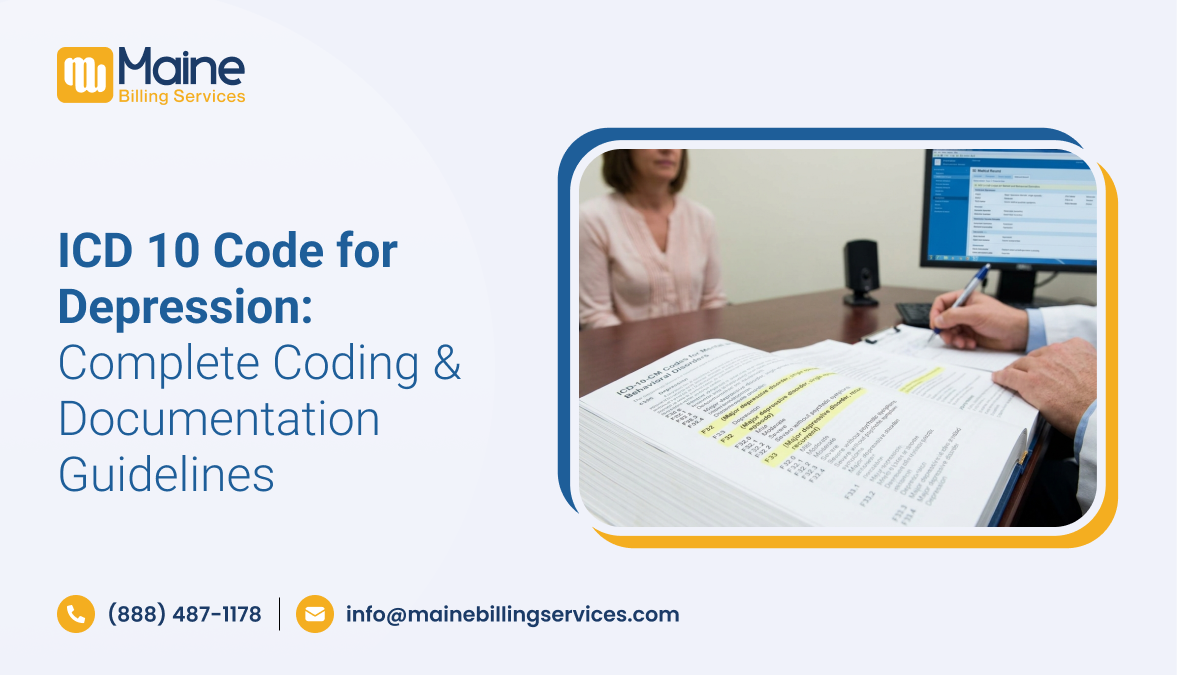
Depression is one of the most common behavioral health conditions documented in medical practices, but assigning the correct ICD 10 code for depression requires more than selecting a general diagnosis from the patient chart. Providers and medical coders must review the clinical documentation, identify the type and severity of the depressive disorder, and make sure the selected code accurately reflects the condition documented for that encounter.
Proper coding of the depression influences a claim submission, medical necessity assessment, payment and the quality of a patient’s medical record. If proof not support the diagnosis selected, claims may be needing additional review or a payment may be delayed.
Understanding the ICD 10 codes for depression, documentation requirements and common coding problems can help mental health clinicians submit better claims and promote correct reimbursement.
What Is the ICD 10 Code for Depression?
There is no one ICD-10-CM code that fits all patients with depression. The correct code is dependent upon the diagnosis documented by the physician.
Common codes include:
- F32.0 — Major depressive disorder, single episode, mild
- F32.1 — Major depressive disorder, single episode, moderate
- F32.2 — Major depressive disorder, single episode, severe without psychotic features
- F32.3 — Major depressive disorder, single episode, severe with psychotic features
- F32.4 — Major depressive disorder, single episode, in partial remission
- F32.5 — Major depressive disorder, single episode, in full remission
- F32.9 — Major depressive disorder, single episode, unspecified
- F33.0 — Major depressive disorder, recurrent, mild
- F33.1 — Major depressive disorder, recurrent, moderate
- F33.2 — Major depressive disorder, recurrent, severe without psychotic features
- F33.3 — Major depressive disorder, recurrent, severe with psychotic features
- F33.40 — Major depressive disorder, recurrent, in remission, unspecified
- F33.41 — Major depressive disorder, recurrent, in partial remission
- F33.42 — Major depressive disorder, recurrent, in full remission
- F32.A — Depression, unspecified
- F34.1 — Persistent depressive disorder
The correct code should come from the provider’s documented diagnosis and the applicable ICD-10-CM coding guidance. Coders should not select a more specific diagnosis simply because it appears clinically possible.
Depression Coding Starts With the Diagnosis
The documented clinical picture determines which depression code family and level of specificity should be considered.
Episode Pattern
Determine whether the documented condition represents a single episode or a recurrent pattern.
Clinical Severity
Use severity information only when it has been established and documented by the provider.
Clinical Status
Consider whether documentation supports active illness, partial remission, or full remission.
Specificity
Choose the level of detail supported by the actual medical record rather than assumptions.
Documentation should drive code selection.
How to Choose the Correct Depression ICD 10 Code
Selecting the appropriate depression diagnosis code starts with reviewing the provider’s assessment and supporting documentation.
Providers and coders should follow the current ICD-10-CM Official Guidelines for Coding and Reporting when selecting and reporting diagnosis codes.
Several factors can affect code selection.
Identify the Type of Depression
The documentation should establish what type of depressive disorder the provider diagnosed. For example, major depressive disorder may be documented as a single episode or recurrent condition.
This distinction matters because the F32 and F33 code families represent different diagnostic patterns.
A coder should not assume that a patient has recurrent depression merely because the patient has received mental health treatment previously. The provider’s documentation should support the diagnosis being reported.
Determine the Severity
The code may also need to include if the major depressive disorder is mild, moderate or severe, as specified by the therapist.
So F32.0 would be a mild single episode and F32.1 would be a moderate single episode. Other specifiers for severe episodes include the presence of psychotic characteristics if verified.
The diagnosis and pertinent clinical findings should be documented by the provider in unambiguous, not vague, terms.
Check for Remission Status
Some depression codes distinguish between active disease and remission.
For recurrent major depressive disorder, documentation may support unspecified remission, partial remission, or full remission. The coder should use the appropriate code only when the provider’s documentation supports that status.
Use Unspecified Codes Appropriately
Codes like F32.9 and F33.9 can be appropriate where the provider has documented severe depressive disorder but has not given the extra specificity required for a more thorough code.
Unspecified coding should not be the default nevertheless. Better clinical documentation can sometimes support a more specific diagnosis.
Depression Documentation Requirements for Providers
Accurate coding begins with accurate documentation. A provider’s note should clearly communicate the condition being evaluated or treated and provide enough information to support the diagnosis.
Depending on the encounter and diagnosis, documentation may include:
- The diagnosed depressive disorder
- Whether the condition is single episode or recurrent
- Severity when clinically established
- Remission status when applicable
- Relevant symptoms and clinical findings
- Treatment plan
- Medication management when applicable
- Psychotherapy or other behavioral health services provided
- Patient response to treatment
- Changes in symptoms or functional status
- Follow-up plan
The goal is not to document information simply for coding purposes. Clinical documentation should accurately describe the patient’s condition and the services provided.
Professional medical coding services can also add an extra level of evaluation and help for practices looking to improve their entire documentation and coding workflow.
F32.9 vs. F33.9: What Is the Difference?
F32.9 and F33.9 are two common searched depression codes however they mean distinct diagnosis.
Major depressive disorder F32.9, single episode, undefined.
F33.9 Major depressive disorder, recurring, nonspecific.
The primary difference is whether the provider has recorded a single episode or recurrent severe depressive illness.
A coder should not automatically assign F33.9 because the patient has a history of depression. The medical record must support the recurrent diagnosis.
Likewise, F32.9 should not be used when the provider has clearly documented a more specific severity or remission status that is supported by the record.
F32.9 and F33.9: The Key Distinction
Single Episode
Used when the provider documents major depressive disorder as a single episode without the additional specificity required for another code.
Recurrent Pattern
Used when the provider documents recurrent major depressive disorder without the additional specificity supported by the record.
A history of previous treatment alone should not be used to assume recurrence. The provider’s current documentation should support the diagnosis reported.
Common Depression Coding Mistakes
Depression coding errors can affect claim accuracy and may create additional work for providers and billing teams.
Choosing a Code Without Supporting Documentation
One common mistake is selecting a specific depression code without sufficient provider documentation.
For example, assigning a severe depression code requires documentation that supports the diagnosis and severity reported.
Confusing Single and Recurrent Depression
F32 and F33 should not be treated as interchangeable categories. The provider’s documentation should establish whether the condition is a single episode or recurrent.
Overusing Unspecified Codes
Unspecified codes have an appropriate role, but they should not replace more specific coding when the documentation clearly supports greater specificity.
Coding Symptoms Instead of the Documented Diagnosis
Symptoms such as sadness, low mood, fatigue, or loss of interest do not automatically establish a specific depressive disorder. Coding should follow the provider’s documented diagnosis and applicable coding rules.
Failing to Update the Diagnosis
A patient’s clinical status can change over time. It should be documented when there are changes in diagnosis, severity or remission status.
Five Questions Before Reporting a Depression Code
Is the diagnosis documented?
Is episode type supported?
Is severity clearly established?
Is remission status relevant?
Does the code match the record?
How Depression Coding Affects Behavioral Health Claims
Accurate diagnosis coding is an important part of the behavioral health billing process. A claim generally includes patient data, provider data, procedure codes, diagnosis codes and payer-specific requirements.
Practices providing behavioral health services should also review the applicable CMS Psychiatry and Psychology Services Billing and Coding Guidelines when Medicare requirements apply.
If the diagnosis does not support the service provided, the payer may request additional information or deny the claim.
For example, problems can occur when:
- The diagnosis does not support the documented service.
- The claim contains an incorrect ICD-10-CM code.
- Documentation does not support the reported diagnosis.
- Provider information is incomplete.
- Eligibility information is incorrect.
- Payer requirements are not followed.
- Required authorization is missing.
This is why mental health billing services often include coding review, claim submission, eligibility verification, and denial follow-up as connected parts of the revenue cycle. Maine Billing Services specifically provides mental health billing support that includes CPT and ICD-10 coding, claim submission, eligibility verification, and denial management.
Depression Coding and Medical Necessity
Diagnosis coding can also help communicate why a behavioral health service was provided.
A diagnosis code should accurately reflect the provider’s clinical assessment and support the medical necessity of the services documented in the record. The diagnosis should not be selected simply because it is likely to receive payment.
Providers should make sure the clinical note connects the diagnosis, symptoms or clinical findings, treatment plan, and services provided.
For behavioral health practices, this connection becomes especially important when treating patients over multiple visits. Consistent documentation helps demonstrate the clinical reason for continued treatment while allowing the diagnosis to be updated when the patient’s condition changes.
How to Reduce Depression Coding Errors
A structured coding workflow can help practices reduce avoidable errors.
Review Documentation Before Coding
Coders should review the complete relevant documentation rather than relying only on a diagnosis carried forward from an earlier encounter.
Match the Code to the Provider’s Diagnosis
The selected ICD 10 code for depression should correspond to the diagnosis documented by the provider.
Check Specificity
Before using an unspecified code, check whether the documentation supports information such as episode type, severity, or remission status.
Review Payer Requirements
Payer policies can differ, so practices should keep their billing workflows current and verify requirements that apply to their patients and services.
Audit Recurring Errors
If the same depression coding issue occurs multiple times, the practice should determine the cause. Provider education, revision of coding, documentation or modifications to the billing workflow are possible solutions.
Professional denial management services can also help practices identify recurring claim problems and address their underlying causes. Maine Billing Services describes its denial-management process as including denial categorization, root-cause analysis, claim rework, appeals, payer follow-up, and trend analysis.
Depression Billing: What Providers Should Review
Before submitting a behavioral health claim, practices should review more than the diagnosis code.
A useful pre-submission checklist includes:
- Patient demographics
- Insurance eligibility
- Provider information
- Diagnosis coding
- Procedure coding
- Modifiers when applicable
- Authorization requirements
- Documentation
- Claim filing deadlines
- Payer-specific billing requirements
A complete review can identify errors before the claim reaches the payer.
Maine Billing Services also says its medical billing process includes eligibility verification, charge capture and code review, claim submission, payment posting, accounts receivable follow-up and reporting.
When Behavioral Health Practices Should Consider Outsourcing Coding
Some practices manage coding internally, while others use behavioral health coding services or outsourced medical billing support.
Outsourcing may be considered when a practice has:
- Increasing claim volume
- Frequent coding errors
- Growing accounts receivable
- Repeated claim denials
- Limited internal billing staff
- Difficulty keeping up with coding updates
- Multiple providers or locations
- Expanding behavioral health services
The aim should be to develop a seamless workflow where paperwork, coding, claim submission, payment posting and denial follow-up complement each other.
For practices that need further help, medical billing services for mental health professionals can combine coding with other revenue-cycle tasks, rather than approach diagnosis coding as an isolated duty.
Depression Coding and Provider Credentialing
Correct coding alone cannot solve every claim problem. A behavioral health practice also needs accurate provider enrollment and payer information.
Credentialing issues might affect compensation if a provider’s information is not fully provided, is outdated or is not correctly enrolled with a payer.
This is especially true for new behavioral health practices, doctors joining group practices and clinicians expanding their payer networks.
Maine Billing Services offers medical credentialing services including provider enrolment, re-credentialing, payer contracting, CAQH maintenance and other enrolment support. Its credentialing page lists the types of providers it services, including behavioral health clinics, psychology, psychiatry, licensed therapists and behavioral analysts.
How to Improve the Depression Billing Workflow
A strong workflow should connect clinical documentation with billing operations.
Start by ensuring providers understand the documentation needed to support their diagnoses. Next, have coders review the documentation and select the appropriate ICD-10-CM code. The billing team can then review the claim for demographic, payer, coding, and authorization issues before submission.
Connecting Depression Coding to the Billing Cycle
Coding accuracy works best when it is connected to the administrative steps before and after claim submission.
After submission, payment posting and accounts receivable follow-up should identify unpaid or underpaid claims. Denials should be categorized so recurring problems can be corrected at their source.
This approach can turn depression medical billing from a series of individual tasks into a repeatable revenue-cycle process.
For additional reading on accounts receivable and denial workflows, see Accounts Receivable Claim Denial Management Services.
Second blog link: I recommend adding a second relevant Maine Billing Services article in this section once a live article URL is confirmed. I have intentionally not inserted an unverified URL.
When to Seek Professional Medical Coding Support
Providers should explore professional coding help if their practice frequently encounters complicated diagnoses, frequent denials, payer-specific requirements or documentation-based billing issues.
Experienced coders can analyze material, spot any coding issues and assist practices in setting uniform coding methods.
This can be particularly valuable for behavioral health clinics that include psychotherapy, psychiatric evaluation, medication management, telemedicine or multiple types of behavioral health treatments.
Maine Billing Services offers medical coding services with the use of ICD-10, CPT and HCPCS coding standards and claims to have a coding team of AHIMA- and AAPC-certified specialists.
Conclusion
The ICD 10 code for depression should always reflect the diagnosis supported by the provider’s documentation. Codes within the F32 and F33 categories can differ according to episode type, severity, psychotic features, and remission status, while other depressive disorders have their own codes.
F32.9, F33.9 are essential codes; however, they should not be treated as the only alternatives. Coders and providers should evaluate documentation closely to choose the best appropriate code.
Accurate diagnostic coding also interfaces with eligibility verification, procedure coding, claim filing, rejection management, credentialing and accounts receivable follow-up. By coordinating these processes, behavioral health practices can develop a more consistent billing system and eliminate needless claim difficulties.
For Maine practices that need broader revenue-cycle support, a Best Maine medical billing company can help connect coding accuracy with billing, claims management, and reimbursement workflows. Maine Billing Services currently offers medical billing support across behavioral health and other specialties in Maine.
Frequently Asked Questions:
What is the ICD 10 code for depression?
There are several ICD-10-CM codes for depressive disorders. The appropriate code depends on the provider’s documented diagnosis, including factors such as episode type, severity, and remission status.
What is F32.9?
F32.9 represents major depressive disorder, single episode, unspecified. It should be used when the provider documents the diagnosis but the record does not support a more specific single-episode code.
What is F33.9?
F33.9 represents major depressive disorder, recurrent, unspecified. The documentation should support recurrent major depressive disorder before this code is assigned.
Can depression coding affect claim reimbursement?
Yes. Incorrect or unsupported diagnosis coding can contribute to claim processing problems, additional documentation requests, or denials. Diagnosis coding should accurately reflect the provider’s documentation and applicable coding requirements.
Should providers always use F32.9 for depression?
No. F32.9 is only one option. More specific codes may apply when the documentation establishes the episode type, severity, psychotic features, or remission status.
Why is documentation important for depression coding?
Documentation supports the diagnosis reported on the claim. Clear documentation helps coders select an appropriate ICD-10-CM code and gives payers information needed to evaluate the submitted claim.
Can mental health billing be outsourced?
Yes. Practices can outsource functions such as coding, claim submission, eligibility verification, denial management, accounts receivable follow-up, and other revenue-cycle activities. Maine Billing Services offers specialized mental health billing support for behavioral health providers.