
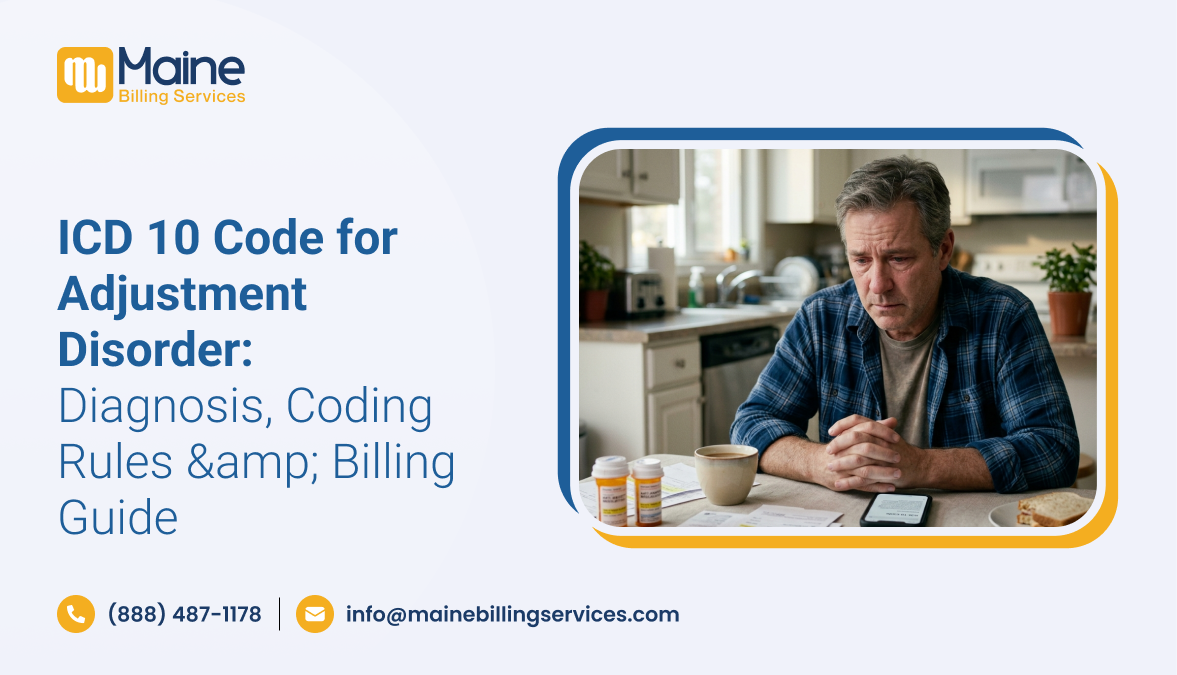
Adjustment disorder can develop when a patient has a significant emotional or behavioral response to an identifiable stressor. For healthcare providers, accurately documenting the diagnosis is important for selecting the appropriate ICD-10-CM code, supporting the medical necessity of services, and submitting complete insurance claims.
Adjustment disorder is classified under the F43.2 category in ICD-10-CM. However, classification for adjustment disorder does not occur simply because symptoms such as anxiety, poor mood or change in behavior have been identified. The provider’s documented diagnostic and clinical information should support the exact code submitted on the claim.
Accurate adjustment disorder coding enables mental health clinicians, primary care clinics and other healthcare organizations to keep consistent records and avoid unnecessary billing issues. This tutorial covers the adjustment disorder ICD-10-CM codes that apply, documentation requirements, coding regulations, typical errors and billing practices providers need to know.
Adjustment Disorder ICD-10-CM
Accurate coding starts with the provider’s documented diagnosis, clinical presentation, and supporting medical record.
✓ Diagnosis
✓ Documentation
✓ Billing
✓ Claims
What Is the ICD 10 Code for Adjustment Disorder?
Adjustment disorders are reported to the F43.2 category, ICD-10-CM. The billable code will depend on the type of adjustment disorder the provider documents.
The current adjustment disorder ICD-10-CM codes include:
| ICD-10-CM Code | Description |
| F43.20 | Adjustment disorder, unspecified |
| F43.21 | Adjustment disorder with depressed mood |
| F43.22 | Adjustment disorder with anxiety |
| F43.23 | Adjustment disorder with mixed anxiety and depressed mood |
| F43.24 | Adjustment disorder with disturbance of conduct |
| F43.25 | Adjustment disorder with mixed disturbance of emotions and conduct |
| F43.29 | Adjustment disorder with other symptoms |
The CDC’s ICD-10-CM classification and CMS coding resources identify these codes for adjustment disorder. Providers and coding professionals should always use the applicable code set for the date of service because ICD-10-CM releases are updated by fiscal year.
For current code files, annual updates, and applicable ICD-10-CM releases, providers can review the CMS ICD-10 Codes and Files page.
Adjustment Disorder Code Selection
F43.20 — Adjustment Disorder, Unspecified
F43.20 is used when the physician records adjustment disorder but does not identify a more specific presentation supported by the classification.
Coders should not select a more specific adjustment disorder code solely because symptoms are noted elsewhere in the record. If the physician didn’t document a specific presentation, the coding team needs to adhere to the applicable coding criteria rather than making its own diagnostic.
F43.21 — adjustment disorder with Depressed Mood
F43.21 identifies adjustment disorder with depressed mood.
The provider’s clinical assessment and the reason the condition is being assessed or treated should be included in the medical record. The examination, treatment plan, and progress reports should be consistent throughout.
F43.22 — adjustment disorder with Anxiety
F43.22 is assigned when the provider documents adjustment disorder with anxiety.
Anxiety symptoms can be present in a number of diseases therefore coders should not automatically assign F43.22 just because anxiety is stated in the patient’s history. The code should be supported by the provider’s written diagnosis.
F43.23 — adjustment disorder with Mixed Anxiety and Depressed Mood
F43.23 is used when the provider documents adjustment disorder with both anxiety and depressed mood.
The documentation should support the mixed presentation and not merely describe one symptom. Clear language in the assessment can assist the coding team in differentiating F43.23 from F43.21 or F43.22.
F43.24 — adjustment disorder with Disturbance of Conduct
F43.24 applies when adjustment disorder is documented with disturbance of conduct.
The medical record should describe the clinically relevant behavioral presentation and connect it to the provider’s assessment. Coders should not infer conduct disturbance from vague behavioral descriptions.
F43.25 — adjustment disorder with Mixed Disturbance of Emotions and Conduct
F43.25 identifies adjustment disorder with a mixed disturbance of emotions and conduct.
The documentation should support both components of the diagnosis. Providers should clearly describe the relevant emotional and behavioral findings when this diagnosis is made.
F43.29 — Adjustment Disorder With Other Symptoms
F43.29 is used for adjustment disorder with other symptoms when the documented presentation supports this code.
The provider’s documentation should explain the clinical presentation sufficiently for the coding team to determine whether F43.29 is appropriate.
Adjustment Disorder ICD 10 Codes: What Providers Should Know
The basic premise in adjustment disorder coding is to report the diagnosis documented by the clinician and documented in the medical record.
“Adjustment disorder might have emotional or behavioral signs following a stressor. However, the existence of anxiety, melancholy, irritation, or behavioral change does not automatically make a diagnosis of adjustment disorder for coding reasons.
Providers should clearly document:
- The diagnosed condition
- Relevant clinical findings
- The stressor or circumstances considered clinically relevant
- The patient’s response and presentation
- The diagnosis selected by the provider
- The treatment plan
- The relationship between the diagnosis and services provided
ICD-10-CM is used in the United States as the clinical modification to categories medical illnesses, per the CDC. The official coding guidelines are utilized to accurately assign codes.
Adjustment Disorder Documentation Requirements for Providers
Accurate documentation gives coders the information they need to assign the appropriate adjustment disorder diagnosis code.
Document the Diagnosis Clearly
The assessment should identify the provider’s diagnosis instead of requiring the coder to interpret symptoms.
For example, noting merely “anxiety after a stressful event” may not provide the same coding help as documenting the particular diagnosis after an adequate clinical evaluation.
Describe the Clinical Presentation
Document relevant symptoms and findings that support the assessment. The record should reflect what the provider evaluated and how the findings contributed to the clinical decision-making process.
Identify the Relevant Stressor
When clinically appropriate, document the significant stressor or life circumstance associated with the patient’s presentation. The record should remain factual and clinically relevant rather than relying on assumptions.
Connect the Diagnosis to Treatment
The treatment plan should correspond to the documented condition and services provided. Clear documentation helps establish why the patient received the reported service.
Keep Documentation Consistent
The diagnosis, assessment, progress notes, treatment plan, and claim should not contradict one another. Inconsistent documentation can create coding questions and may contribute to claim delays or denials.
Build a Clear Clinical Record
Documentation should give the coding and billing team enough information to understand the provider’s diagnosis and the services delivered.
Document the Diagnosis
Describe Clinical Findings
Identify the Relevant Stressor
Connect Diagnosis to Treatment
Maintain Consistency
Adjustment Disorder Coding Rules for Medical Billing
Adjustment disorder coding is only one part of the claim submission process. The diagnosis code should work together with the CPT code, documentation, patient information, insurance coverage, and payer requirements.
Providers and coding professionals can also refer to the ICD-10-CM Official Guidelines for Coding and Reporting when reviewing applicable coding and documentation requirements.
Before submitting a claim, providers and billing teams should review:
- Patient demographics
- Insurance eligibility
- Provider information
- ICD-10-CM diagnosis coding
- CPT coding
- Modifiers when applicable
- Authorization requirements
- Documentation
- Payer-specific requirements
- Timely filing requirements
Practices might utilize medical coding services to evaluate diagnosis and procedure coding prior to claim submission. Maine Billing Services said their coding team adheres to the coding guidelines of ICD-10, CPT and HCPCS.
Adjustment Disorder Billing: ICD-10-CM and CPT Codes
Providers should distinguish between diagnosis codes and procedure codes.
ICD-10-CM codes identify the patient’s diagnosis or condition. CPT codes generally identify the professional service performed.
For example, a mental health provider may report a psychotherapy or psychiatric service using the applicable CPT code while using an adjustment disorder ICD-10-CM code to identify the documented diagnosis.
The CPT code to bill is not automatically determined by the diagnosis of adjustment disorder. The CPT code must be a true representation of the service done and documented.
This distinction is important because a correct diagnosis code cannot compensate for incomplete service documentation or an incorrect procedure code.
For practices that need specialized support, mental health billing services in Maine include mental health coding, claim submission, eligibility verification, denial management, and other revenue-cycle functions.
Common Adjustment Disorder Coding Errors
Even when adjustment disorder appears straightforward, coding and documentation problems can affect claims.
Coding From Symptoms Instead of the Provider’s Diagnosis
Symptoms such as anxiety or depressed mood should not automatically determine the diagnosis code. The provider’s documented diagnosis should guide code selection.
Choosing an Unspecified Code When Documentation Supports More Specificity
If the provider clearly documents a specific adjustment disorder presentation, the coding team should review whether the corresponding specific code is supported rather than defaulting to F43.20.
Combining Conditions Without Clear Documentation
A patient may have symptoms associated with multiple mental health conditions. Providers should clearly document the diagnosis being assessed or treated instead of leaving the coder to determine which condition is primary.
Incomplete Clinical Documentation
Missing assessment details, unclear treatment rationale, or inconsistent progress notes can make it difficult to support the diagnosis and services reported.
Diagnosis and Procedure Mismatch
The diagnosis code and CPT code should correspond logically to the encounter. A mismatch may result in payer questions or claim denial.
Ignoring Payer-Specific Requirements
Insurance plans may have different requirements for authorization, documentation, covered services, and claim submission. Providers should verify payer requirements before billing whenever appropriate.
For a broader review of coding problems that can affect reimbursement, providers can read Common Medical Coding Errors.
Avoid These Common Coding Problems
Coding From Symptoms
Anxiety or depressed mood alone should not automatically determine the adjustment disorder code.
Unnecessary Unspecified Coding
Review whether the documentation supports a more specific adjustment disorder code.
Incomplete Documentation
Missing assessment details or treatment rationale can make claim support more difficult.
Diagnosis & CPT Mismatch
The diagnosis and procedure codes should accurately represent the documented encounter.
Ignoring Payer Requirements
Authorization, documentation and claim rules may vary by payer and should be reviewed.
Submitting Without Review
Review patient, insurance, coding and filing details before submitting the claim.
How Insurance Eligibility Verification Supports Adjustment Disorder Claims
Insurance verification should be part of the revenue-cycle workflow for mental health services.
Behavioral health benefits can include coverage limitations, deductibles, copayments, network requirements, authorization rules, or visit limitations. Verifying eligibility and benefits before treatment can help practices identify potential coverage issues before a claim is submitted.
Maine Billing Services provides insurance eligibility verification for Maine practices and identifies mental health and behavioral health providers among the practices it serves.
Eligibility verification does not replace accurate ICD-10 coding or clinical documentation. Instead, it addresses another part of the claim process that can contribute to avoidable billing problems.
Adjustment Disorder Claims and Denial Management
A denied adjustment disorder claim should be reviewed according to the payer’s stated reason rather than simply resubmitted.
Common problems can include:
- Incorrect diagnosis coding
- Incomplete documentation
- Eligibility issues
- Authorization problems
- CPT and ICD-10 mismatches
- Medical necessity concerns
- Incorrect patient information
- Timely filing issues
- Payer-specific claim edits
A denial management process should identify the underlying cause, determine whether a corrected claim or appeal is appropriate, and address recurring problems in the billing workflow.
Maine Billing Services’ denial management services include root-cause analysis and support across behavioral health and other specialties.
Documentation problems can also contribute to recurring denials. The site’s article on clinical documentation and medical billing discusses concurrent record review, provider education, coding feedback, and documentation improvement as components of a stronger billing workflow.
Adjustment Disorder Billing for Mental Health and Primary Care Providers
Adjustment disorder may be seen in behavioral health, general care and other health care settings.
Mental health professionals are educated to assess and treat the people when symptoms interfere with the emotional functioning, everyday activities, relationships, or other elements of the life. Primary care providers may be potentially recognize behavioral health disorders and also provide referrals for care from mental health professionals during routine or problem-oriented visits.
Specialty billing workflows can help practices that provide behavioral health services connect clinical documentation to coding, claims, eligibility and payer criteria.
For primary care practices, Family Medicine Billing Services in Maine includes CPT and ICD-10 coding, eligibility verification, claims submission, and payer-related billing support.
When Should Providers Consider Professional Medical Billing Support?
Adjustment disorder coding is only one responsibility within a healthcare practice’s revenue cycle. Providers and office managers additionally may have to handle eligibility verification, charge entry, coding, claim submission, payment posting, accounts receivable, denials and payer communication.
If these administrative tasks are becoming tough to manage internally, professional billing help can provide operational resources.
A medical billing company may assist with:
- ICD-10-CM and CPT coding
- Claim preparation and submission
- Insurance eligibility verification
- Claim follow-up
- Denial management
- Accounts receivable follow-up
- Payment posting
- Revenue-cycle reporting
- Documentation and coding review
Maine Billing Services is a full-service medical billing and coding organization. Our end-to-end services include claim filing, AR follow-up, insurance verification, coding, payment posting, credentialing and rejection management.
The group gives revenue-cycle support to providers in Maine in several specialties and practice types who want more complete medical billing services.
Conclusion
The first step in accurate coding of the ICD 10 code for adjustment disorder is a thoroughly documented provider diagnosis. Adjustment disorder is now coded using ICD-10-CM codes F43.20, F43.21, F43.22, F43.23, F43.24, F43.25 and F43.29. Select the appropriate code according to the clinical presentation reported.
Providers should not code merely by symptom. Providers should discuss the diagnosis and related clinical findings, document the diagnosis with appropriate documentation, and verify that the encounter is appropriately coded in ICD-10-CM and CPT coding.
A sustainable revenue cycle depends on accurate coding. However, for successful claim processing, it is also required to verify eligibility, document correctly, code the procedures correctly, submit on time and follow-up on rejections.
Maine Billing Services offers billing services to the healthcare professionals in a state of the Maine including practices who requires assistance with the behavioral health billing, coding, claims, eligibility and a revenue cycle management.
Frequently Asked Questions About the ICD 10 Code for Adjustment Disorder
What is the ICD 10 code for adjustment disorder?
Adjustment disorder is reported within the F43.2 category. The specific ICD-10-CM codes include F43.20, F43.21, F43.22, F43.23, F43.24, F43.25, and F43.29.
What is the ICD 10 code for adjustment disorder with anxiety?
The ICD-10-CM code for adjustment disorder with anxiety is F43.22.
What is the ICD 10 code for adjustment disorder with depressed mood?
The ICD-10-CM code for adjustment disorder with depressed mood is F43.21.
What is the ICD 10 code for adjustment disorder with mixed anxiety and depressed mood?
The ICD-10-CM code is F43.23 for adjustment disorder with mixed anxiety and depressed mood.
What is the ICD 10 code for adjustment disorder with disturbance of conduct?
The ICD-10-CM code is F43.24 for adjustment disorder with disturbance of conduct.
What is the ICD 10 code for adjustment disorder with mixed disturbance of emotions and conduct?
The ICD-10-CM code is F43.25.
Is F43.20 a billable adjustment disorder code?
Yes. F43.20 adjustment disorder, nonspecific. • Adjustment disorder, where the provider’s data supports adjustment disorder but does not demonstrate a more precise presentation.
Can coders select the adjustment disorder type from symptoms?
Coders should not diagnose the patient or deduce a more specific diagnosis from symptoms alone. The coding assignment should be based on the provider’s documentation of the diagnosis and the relevant coding recommendations.
Does an adjustment disorder ICD-10 code determine the CPT code?
No. ICD-10-CM codes are used to indicate diagnoses; CPT codes generally define the professional services provided. Both should be an accurate reflection of the encounter and supporting documentation.