
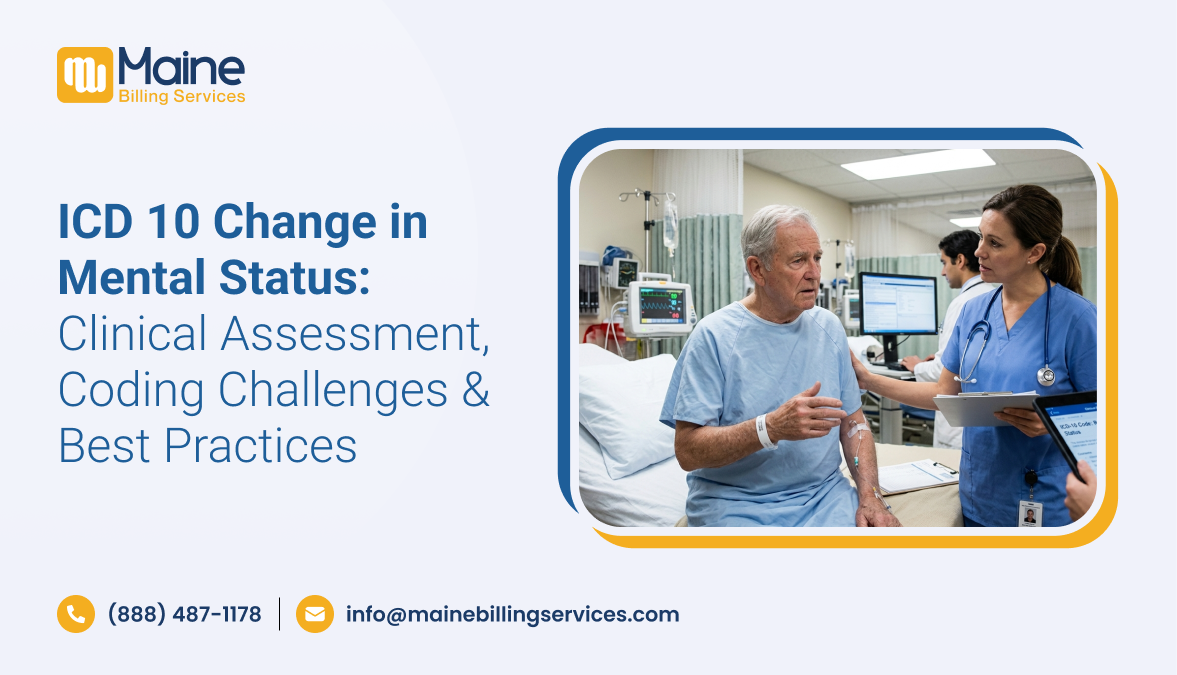
A change in mental status can represent a transient abnormality, an underlying disease process, or an acute clinical problem that requires immediate intervention. Patients present with confusion, disorientation, decreased alertness, and inability to concentrate, among other manifestations. Proper coding of this condition is essential for medical professionals since it plays a role in determining patient billing.
Choosing the right ICD 10 change in mental status code is critical and should be determined by a professional’s symptoms, assessment, and a confirmed diagnosis, if available. Although R41.82 is often related to the presence of altered mental status, this code is not always adequate for the patient’s presenting problems.
Medical coders encounter various challenges when distinguishing between an identified symptom and a confirmed disease while following the ICD-10-CM instructions. At the same time, coding errors result in rejected claims and delayed reimbursements.
This article reviews diagnosis codes, documentation rules, and typical coding scenarios that effect change in mental status.
What Does a Change in Mental Status Mean?
Altered Mental Status:Recognize the Signs
Recognizing the patient’s specific changes helps clinicians document the encounter clearly.
Confusion
Difficulty understanding information or following conversations.
Disorientation
Difficulty identifying time, place, or the current situation.
Reduced Alertness
A noticeable change in wakefulness or responsiveness.
Memory & Attention
Changes in recall, focus, thinking, or communication.
✓
**Documentation tip:** Record what changed from the patient’s usual baseline and what the clinician observed.
A change in mental state is a generic term that refers to a decrease or rise in the level of consciousness, orientation, attentiveness, or activity from the norm. So it’s not a specific diagnosis that suggests a number of reasonable possibilities. Instead , medical personnel examine the manifestations and use them to determine what the underlying ailment is.
The disruption might begin quickly or gradually and the changes can be modest or severe.
Common presentations include:
- Confusion: Difficulty understanding information, following conversations, or interpreting surroundings.
- Disorientation: Trouble identifying the time, location, situation, or other relevant details.
- Altered awareness: A change in alertness or responsiveness.
- Cognitive changes: Difficulties with attention, memory, or thinking.
- Behavioral changes: Unusual behavior or difficulty communicating compared with the patient’s baseline.
A change in mental status can develop in the intensive care unit, hospital, physicians’ office, or neurology practice. A patient may show a rapid change in awareness, along with other acute neurological symptoms, which require emergent care. On the other hand, some changes in mental status are not always serious and only suggest the need for additional tests.
ICD 10 Change in Mental Status: Common Diagnosis Codes
A wide range of conditions can be related to a change in mental status. In turn, there is no particular code that is suitable for all scenarios. The coder should rely on the symptoms described, the professional’s assessment, and specific guidelines.
The following table summarizes commonly relevant codes for coding review.
| ICD-10-CM code | Description | Coding consideration |
| R41.82 | Altered mental status, unspecified | Consider when altered mental status is documented without a more specific established diagnosis |
| R41.0 | Disorientation, unspecified | Relevant when the documented finding is unspecified disorientation |
| R41.89 | Other symptoms and signs involving cognitive functions and awareness | May apply to other documented cognitive symptoms when no more specific code is appropriate |
| R41.3 | Other amnesia | Relevant to documented memory-loss or amnesia presentations covered by the code |
| R40.4 | Transient alteration of awareness | May apply when the provider documents a transient alteration of awareness consistent with the code |
| F05 | Delirium due to known physiological condition | Requires documentation supporting delirium due to a known physiological condition |
| G93.41 | Metabolic encephalopathy | Requires a documented diagnosis of metabolic encephalopathy |
| G93.40 | Encephalopathy, unspecified | May apply when encephalopathy is documented but not further specified |
These codes are samples, not interchangeable equivalents. Always check the most current ICD-10-CM Alphabetic Index, Tabular List including the inclusion terms, exclusions and any supplementary coding instructions in each submission.
One Symptom.
Different Coding Paths.
Code selection depends on the documented finding, established diagnosis, and applicable coding instructions.
May apply when altered mental status is documented without a more specific established diagnosis.
Consider when the provider documents unspecified disorientation.
Requires documentation supporting the specified diagnosis.
Use the code supported by the provider’s documented encephalopathy diagnosis.
These codes are not interchangeable. Verify the current ICD-10-CM Alphabetic Index, Tabular List, exclusions, and official coding instructions before claim submission.
When Is R41.82 Appropriate?
R41.82 can be applied in many cases, depending on the provider’s findings, patient’s symptoms, and supporting documentation. It is appropriate when the provider documents altered mental status, without specifying additional details that fall under other codes.
For instance, an emergency physician can evaluate a patient for an abrupt change in awareness and report altered mental status while waiting for additional tests.
As a coder, you should ensure that the documentation is appropriate in terms of the patient’s setting and apply the corresponding guidelines. That is, a probable diagnosis should not be reported as a verified sickness at an outpatient clinic.
Coders should follow the official ICD-10-CM coding guidelines to ensure that diagnosis selection, documentation, and reporting comply with the requirements for the applicable care setting.
R41.82 should not be the usual code for all patients who are disoriented, confused, or with memory impairment. The coder should interpret and use the coding rules as appropriate if the clinician states a definitive diagnosis.
When Should a More Specific Code Be Considered?
Selecting a change in mental state should be done only if the provider documents no more specific observations or symptoms that are more relevant and descriptive.
For example, if disorientation is noted, but not stated, the coder should consider code R41.0. Here’s another example of why the provider should use the correct code based on a proven diagnosis. If the provider documents metabolic encephalopathy, code that and not the general symptom.
The important part is to understand the diagnosis the clinician has made and choose the appropriate ICD-10-CM code. Do not assume the diagnosis based on lab work, a known chronic disease, or any other assumption.
Clinical Assessment and Documentation Requirements
Accurate classification of mental status begins with an accurate clinical record. The provider’s note should include what changes were seen, the pertinent exam, and the impression from the visit.
Establish the Patient’s Baseline
The medical record should detail the patient’s regular cognitive functioning and, if available, explain how the current presentation varies.
This information may be particularly pertinent when considering elderly patients, those with known cognitive impairment, or persons with poor usual communication skills.
For example, a patient who is generally attentive and orientated but who becomes suddenly confused looks different than a patient with a known persistent cognitive impairment and without new symptoms.
Document the Observed Findings
the medical record should describe the findings in detail instead of stating a general diagnosis, such as “change in mental status.”
Depending on the setting and the provider’s assessment, the notes can include a number of relevant details:
- Level of alertness and responsiveness.
- Orientation to person, place, time, or situation.
- Changes in attention, memory, or communication.
- Reported onset and duration of symptoms.
- Relevant neurological or physical findings.
- Clinical assessment and diagnostic conclusions.
Coders should not add findings that the provider did not document.
Identify the Confirmed Diagnosis
The signs of a change in mental status can vary, thus it is not unusual for the provider to just pick up on particular symptoms. A more specific diagnosis can help you select the proper code for the claim.
If the clinician does identify a specific underlying illness, coders should determine if symptom codes should be assigned along with the diagnosis.
Alternatively, the patient’s symptoms may not support a specific diagnosis, and a generic code for a symptom is the only appropriate alternative. In all cases, coders should rely on the instruction and guidelines related to assigned codes.
Clarify Incomplete or Conflicting Records
When documentation is unclear or incomplete, coders should refer to the applicable clarification or query protocols. Queries enable coders to receive additional information from the provider that is necessary to assign the right code(s).
Keep in mind that a query should be designed in a neutral manner and should not attempt to prompt the physician toward detecting a disease that would pay the claim.
From Clinical Observation
to a Supported Code
A structured review connects the clinical record with accurate diagnosis coding.
Establish Baseline
Review the patient’s usual cognitive function and relevant history.
Record Findings
Describe the change, onset, duration, responsiveness, and relevant examination findings.
Review Assessment
Identify the provider’s documented conclusion without assuming an underlying cause.
Verify the Code
Check official code descriptions, instructions, and care-setting rules.
Follow your organization’s compliant provider-query process to resolve missing or conflicting information. Never add clinical findings that the provider did not document.
Understanding the Difference Between Confusion, Delirium, and Encephalopathy
These terms can overlap in clinical presentations, but they do not mean the same thing for coding purposes.
Confusion
Confusion is a general term that refers to a set of symptoms affecting a person’s perception of his surroundings. It can be related to cognitive dysfunction, with altered awareness.
If the provider documents confusion, R41.0 or R41.82 can be chosen, depending on the additional descriptions.
Delirium
Delirium is an acute disturbance in attention and consciousness with additional concomitant behavioral or cognitive impairment.
It is a syndrome that can be produced by a number of events. If the physician documents delirium due to a physiological condition, the coder should evaluate F05.
Behavioral health practices can benefit from specialized mental health billing services in Maine to support accurate diagnosis coding, documentation review, and compliant claim submission.
For additional clinical background, healthcare professionals can review information about delirium symptoms and causes, including changes in attention, awareness, and thinking.
Encephalopathy
Encephalopathy is a broad term for a condition that affects the normal functioning of the brain.
It can be associated with a range of symptoms from personality changes to changes in states of consciousness. The coder is required to use the specified rules to determine the correct ICD-10-CM code.
For example, G93.41 is metabolic encephalopathy while G93.40 is nonspecific encephalopathy .
How Underlying Conditions Affect ICD-10-CM Code Selection
There are many medical diseases that might lead to changes in mental status. The selection and sequencing of diagnosis and any extra codes is dependent on the verified cause.
Infection-Related Changes
Some people may become confused or alter in their level of alertness due to an acute infection. Coding team should identify if infection was noted by the physician and if delirium or a condition associated with it was also noted.
This confusion itself does not indicate sepsis, urinary tract infection or any infection.
Metabolic and Medication-Related Causes
Cognition or consciousness may be affected by metabolic reasons or by the harmful effects of drugs. If a particular cause has been identified, the coder should review the diagnosis and adhere to any directions for further codes.
A coder should not report metabolic encephalopathy or a medication-related diagnosis solely based on abnormal laboratory results or the presence of a medication in the patient’s record.
Neurological Conditions
If patient has altered level of consciousness or cognition as a result of stroke, seizures, or other neurological condition, then provider documents a definite neurological diagnosis and the code team should select neurological code for the type of stroke or neurological diagnosis per documentation and coding guidelines.
The coder will need to check the inpatient/outpatient criteria, the physician’s documentation, and the orders for a suspected ailment that has not been diagnosed yet and was previously under investigation.
For emergency departments, accurate coding also requires the coder to review the workup and the encounter complexity. See our linked article, The Financial Impact of Under-Coding High-Acuity Emergency Visits, for documentation and coding considerations for emergency departments.
Common Coding Challenges and How to Avoid Them
Avoid the Guesswork.
Code What Is Documented.
A consistent coding review helps prevent unsupported diagnoses and avoidable claim problems.
×
Common Pitfalls
A general status-change code may overlook a more specific documented finding.
Laboratory results or medication history alone do not establish a diagnosis.
Incomplete or conflicting records may need clarification before code assignment.
✓
Better Practices
Select a code that reflects the provider’s documented finding or diagnosis.
Check current ICD-10-CM instructions and the applicable care-setting rules.
Use compliant queries when necessary instead of making unsupported assumptions.
Coverage, medical necessity, documentation, claim details, and payer requirements also matter.
Coding mental status can be difficult when physicians use vague phrases or list many symptoms.
Using R41.82 for Every Presentation
Confusion, disorientation, amnesia and altered consciousness are not usually same.
Best practice: Choose the code according to the described condition and the directions. If a particular diagnosis is made, report the specific diagnosis rather than a generic mental state change.
Coding a Suspected Cause as Confirmed
An assessment may show infection, stroke, side effect of medication or metabolic imbalance without confirming any of those diseases.
Best Practice: Implement guidelines for inpatient or outpatient. If there’s no allowance for diagnosis without confirm, coder should not claim for it to be confirmed.
Reporting Symptoms Already Included in a Diagnosis
Some symptoms are linked to a recognized disease and should not be reported as separate conditions.”
Best practice Refer to the ICD-10-CM guidelines and to the official guidance for any further codes to apply.
Overlooking Documentation Gaps
A general notation of “confused” may not be enough to select a specific code.
Best practice: Utilize compliant provider queries, when necessary, and make sure the final code is fully supported by the documentation.
Ignoring Claim-Specific Requirements
An appropriate diagnosis code alone will not have an insurance pay a claim. Reimbursement may vary based on coverage, medical necessity, claim-specific considerations, and other factors, including payer-specific laws.
Best practice: Review the full claim and analyze each refusal based on the precise reason before submitting the claim”.
Best Practices for Accurate Mental Status Coding and Billing
Healthcare practices can enhance the accuracy of coding by implementing a standardized review process.
- Review the entire encounter, including the assessment, findings, final diagnosis, and discharge documentation.
- Determine the setting of care and apply the appropriate coding instructions.
- Verify the code against the description and instructions in the current ICD-10-CM.
- Review the diagnosis sequence and follow any official sequencing instructions and conventions.
- Validate the claim and ensure that the reported diagnoses and services are consistent with the documentation and the insurer’s requirements.
- Analyze the recurring errors, edits, and claim rejections to improve the quality of coding and documentation.
Healthcare practices seeking additional support with claims processing, reimbursement follow-up, and billing accuracy can explore medical billing services in Maine tailored to their operational needs.
Practices that need additional support can work with professional medical billing companies in Maine to address claim submission, review, and other services.
How Medical Coding and Denial Management Support Reimbursement
Accurate coding is only part of the revenue cycle. Billing and practice management professionals should also have the expertise and processes required to submit claims, obtain reimbursement, and follow up on any denied claim.
Medical Coding Review
Medical coding services can find unsupported or invalid diagnoses, inconsistencies between the record of care and the claim and other areas for improvement.
In practice with mental health, in order to explore the coding of the mental state one has to be aware of the difference between symptoms and behavior health. Not all changes in mental status represent a mental health condition.
Claim Denial Management
When a claim has been refused, the billing team should analyze the rationale, the paperwork, and the alternatives for resubmission or appeal.
Our denial management services can assist healthcare organizations in addressing coding errors, paperwork challenges, medical necessity, and other causes of denial.
For more information on denial management services, please review our guide to Accounts Receivable Claim Denial Management Services.
Specialty-Specific Billing Support
Documentation and reimbursement expectations may differ based on the specialty. Emergency departments might be required to report on high acuity contacts, neurology practices on specific neurological diseases, and behavioral health practices on a variety of mental health symptoms.
For these and many other specialties physicians can partner with billing and coding professionals in Maine to address specialty-specific paperwork and reimbursement problems.
Maine Billing Services also provides a package of services to help healthcare businesses standardize and streamline their billing and coding operations.
Final Thoughts
ICD 10 Coding for Altered Mental Status Change in mental status does not qualify for correct classification under general diagnosis. Providers and coders need to be able to tell the difference between symptoms, syndromes and diagnosed diseases and only report those that have really been documented in the record.
R41.82 may be appropriate for an unspecified alteration in mental status, but other codes may be more specific and accurate, depending on the provider’s assessment and instructions.
Documentation, validation of code, and a standardized billing process can assist reduce coding errors and allow for prompt addressing of refused claims through systematic reviews.
Healthcare providers looking to improve coding accuracy, streamline claim processing, and address reimbursement challenges can explore the best medical billing services in Maine to support their practice’s billing and revenue cycle needs.
Frequently Asked Questions
What is the ICD-10-CM code for a change in mental status?
Altered mental condition, undefined R41.82 ICD-10-CM Code This may be useful if the clinician has not established a more specific diagnosis. Other codes may be more appropriate if the record includes a more precise symptom or a proven disease.
Is R41.82 the same as confusion?
R41.82 represents altered mental status, unspecified, while confusion can be a symptom or part of the more specific diagnosis. Always select the code based on the provider’s documentation.
What ICD-10-CM code is used for disorientation?
R41.0 represents disorientation, unspecified. The coder should review the documentation and verify the instructions before selecting the code.
Can altered mental status be coded with encephalopathy?
Depends on documentation and instructions. If encephalopathy has been confirmed, the coder should review the encephalopathy ICD-10-CM codes and follow the directions for subsequent diagnoses.
Does R41.82 guarantee insurance reimbursement?
ICD 10 change in mental status codes are not enough to guarantee reimbursement. Every practice should review the patient’s insurance, medical necessity, documentation, and other requirements before claim submission. The correct diagnosis code is only one part of the process.
How can medical billing services help reduce coding-related denials?
Medical billing professionals are able to assess the claim, determine the cause for the denial and decide what to do next. They will be able to follow the proper process with the accompanying paperwork if a claim needs to be resubmitted or appealed.