
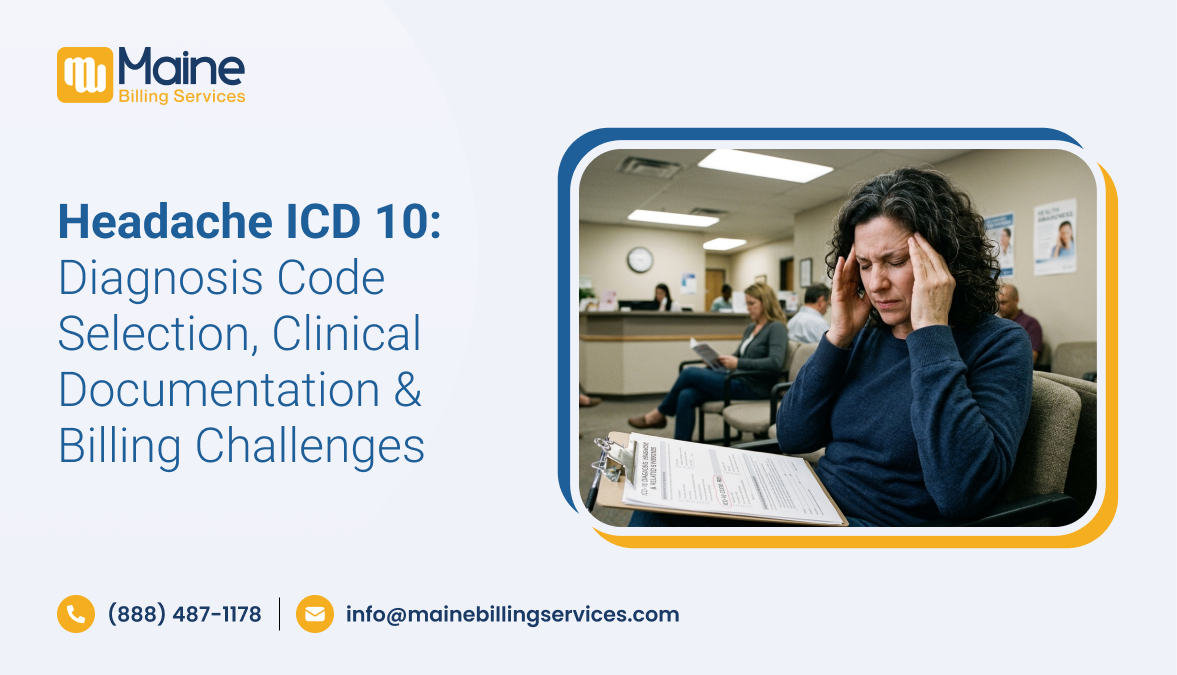
Headaches are among the most prevalent complaints encountered both in everyday life and in a physician’s office. They can be an occasional annoyance, a recurring problem, or the main concern related to a diagnosed neurological disorder. However, choosing the right headache ICD 10 code for billing and reimbursement involves more than the patient’s complaint of headache. To choose the right code, coders and billers need to consider what diagnosis the provider has made based on the information in the medical record. An unspecified headache, a headache with an orthostatic component, and a diagnosed migraine are different conditions requiring different diagnoses.
Failure to code a patient’s complaint in accordance with the provider’s assessment and documentation may result in a denied or delayed claim. This article examines typical ICD 10 codes for headache, differences between symptom diagnosis and headache disorder diagnosis, and what practices may do to assure accuracy of their documentation and claims. It also reviews the most common causes of documentation problems and coding and billing errors and solutions to improve coding accuracy.
Accurate coding starts with the provider’s assessment, not simply the patient’s description of pain.
Identify the condition established by the provider.
Distinguish an unspecified headache from a diagnosed headache disorder.
Verify the diagnosis against the applicable ICD-10-CM code set.
Overview of Headache ICD 10 Coding Considerations
A headache is a symptom that may have multiple causes. Some patients suffer from occasional headaches without a confirmed diagnosis, while others have a migraine or another condition determined by the provider.
ICD-10-CM assigns diagnosis codes based on the provider’s documentation. Coders are not responsible for determining the cause of a patient’s symptoms. Instead, they must rely on the provider’s assessment and the documented justification of their diagnosis.
Accurate coding of headache disorders enables practices to
- report the provider’s documented diagnosis accurately
- demonstrate the medical necessity of the services rendered
- maintain consistency between the provider’s notes and the insurance claim
- avoid claim rejections and denials resulting from coding errors
- ensure appropriate reimbursement and accurate financial reporting
It is especially important for practices seeing patients with recurring symptoms to have consistent coding practices. This is essential to help the practice’s billing team differentiate between diagnosis of symptoms and disorders requiring specialized care.
Common ICD 10 Codes for Headache
A practitioner’s documented diagnosis determines the appropriate ICD 10 code for a patient’s headache. Several common ICD 10 codes applicable to headaches are described below.
The record does not establish a more specific headache diagnosis.
Use when the documented diagnosis supports this classification.
For the documented migraine diagnosis meeting the code description.
Use when the documented diagnosis supports these characteristics.
Before utilizing any of these or other ICD-10-CM codes, coders need to make sure the documentation supports the diagnosis and that they use the current version of the code set. For the latest up-to-date coding guidance’s and norms, please visit the official CMS ICD-10-CM website.
Before submitting claims, coders should verify diagnosis descriptions and applicable annual updates using the official ICD-10-CM coding guidelines published by CMS.
R51.9: Headache, Unspecified
R51.9 is the most common diagnostic code for Headache, nonspecific. It is applicable when the physician verifies a headache but fails to note other particular symptoms.
An example of such a scenario is a patient coming in for a checkup with a complaint of headache. After examination, the provider concludes that the patient’s symptoms are consistent with headache but does not identify its type or an underlying disorder.
In such cases, R51.9 is appropriate if the documentation does not establish the presence of a more specific diagnosis.
Coding considerations: Using an unspecified code should not be the default option for any diagnosis. Coders must always review the entire record to determine if the provider documented additional details establishing the presence of a more specific diagnosis.
R51.0: Headache With an Orthostatic Component
R51.0 is used to report a headache with an orthostatic component that has not been identified as related to another diagnosed disorder. An orthostatic headache is characterized by discomfort associated with changes in the patient’s position, particularly when moving from lying or sitting to standing.
When determining the appropriateness of this code, coders must remember that the provider’s documentation of an orthostatic headache is still required.
It is not sufficient for the patient to report only feeling lightheaded or uncomfortable in certain positions. Coders also should seek clarification from the provider if the provider’s documentation shows the potential for another diagnosis. The query must meet HIPAA compliance and be CMS-approved, if applicable.
When to Use Migraine or Tension-Type Headache Codes
Not every documentation of a headache must be coded as an unspecified symptom. If the provider documents that the patient’s symptoms are consistent with a specific disorder, the billing department should use the relevant set of codes describing this diagnosis.
The migraine codes are located under category G43 while the tension-type headache codes are located under category G44.2. There are multiple different options for the headache type for each category including intractable migraine or tension type headache. For instance, nonspecific migraine has a code of G43.909 unspecified tension-type headache not intractable G44.209.
Providers assessment should be checked for guidance to the coder when selecting codes from these sections. In particular, they must ensure that the documentation supports the presence of any additional complications specified in the code description.
Neurology practices handling migraine and other diagnosed headache disorders may need specialty-specific billing support to maintain accurate diagnosis reporting and meet payer requirements; explore neurology billing services in Maine for relevant support.
How to Select the Correct Headache Diagnosis Code
A standardized approach to code selection can reduce errors and facilitate communication between the coders and the rest of the practice.
The following points describe a simple algorithm that can help in selecting the appropriate code:
Step 1: Doctor’s diagnosis. Find out whether the visit is for headache symptom or headache disease.
Step 2: What is the level of specificity? Does the provider identify migraine, tension-type headache, an orthostatic component, or other a specific condition?
Step 3: Check the content of the code. Some codes differentiate between the intractable and non-intractable state, and some treat status migraineurs. If the record does not include this information, then do not differentiate in your code.
Step 4: Consult the approved code guidelines. Review current code description, inclusion terms, exclusion notes and any sequencing requirements, if relevant.
Step 5: Fill in holes in documentation. If the record is inconsistent or does not support a necessary distinction, clarify through the practice’s established question process.
A repeatable review process helps align diagnosis reporting with the medical record.
Determine whether the documented condition is a headache symptom or a diagnosed headache disorder.
Review documented details that distinguish an unspecified headache, orthostatic headache, migraine, or tension-type headache.
Confirm that any documented features required by the selected code, such as intractability, are supported.
Validate the current code description, inclusion and exclusion notes, and applicable guidelines.
Use the practice’s approved clarification process when the record is unclear or inconsistent.
Reviewing common medical coding errors can help billing teams recognize problems with diagnosis specificity, documentation, and code selection before submitting claims.
This method of selecting codes is far more efficient than simply looking at the patient’s major complaint.
Clinical Documentation Requirements for Headache Coding
The documentation in the medical record must be sufficient to enable billing and coding in accordance with the provider’s diagnosis. It should comply with the documentation requirements established for the services provided and relevant to the diagnosis.
However, several general rules and recommendations can help coders and billers ensure that the documentation is appropriate for the selected code.
Symptom History and Clinical Presentation
When applicable, the provider may document information relating to the patient’s symptom history and current presentation. This may include the timing and duration of the symptom, its frequency and severity, and the location and nature of discomfort.
Understanding headache symptoms and common types can provide useful clinical background, although diagnosis-code selection must remain based on the treating provider’s documented assessment.
This information may help the provider determine the cause of the symptom. However, coders and billers must not attempt to determine the diagnosis based on the symptoms.
Provider Assessment and Diagnosis
The provider’s assessment must demonstrate that they have correctly identified the disorder based on the patient’s symptom history and examination results. If the provider documents that the patient has migraine, tension-type, or another diagnosed headache disorder, the record should indicate why this is the case.
The billing team should always attempt to clarify discrepancies between the provider’s diagnosis and the documentation.
Relevant Findings and Treatment Plan
The medical record may contain additional relevant findings, investigations, and treatment recommendations. For example, it should describe the provider’s reasoning when adjusting the patient’s treatment or recommending additional diagnostics for recurrent headaches. This information may help coders understand the context of the appointment but should not be used to identify a diagnosis that the provider has not established.
Consistency Across the Claim
Diagnosis filed with the claim must be consistent with the rest of the claim and the medical record. Payers are more inclined to reject claims with documentation inconsistencies and gaps.
Through an examination of documentation improvement factors and constant contact between coders and clinicians, practices can lessen the incidence of such problems.
Headache ICD 10 Billing Challenges That Practices Should Watch For
Correct diagnosis codes only form a portion of the overall claims puzzle. Many administrative or documentation details also play a role in claim rejections.
Primary care practices managing recurring headache complaints can benefit from family medicine billing services in Maine to support accurate coding, claim submission, and payer follow-up.
Using An Unspecified Code When Further Detail Exists
An unspecified headache code may only be assigned when a deferential diagnosis has not been made.
Billing teams could consider a more detailed review of the progress note prior to assigning a diagnosis code. It is often not enough to identify the reported symptom.
Confusing Headache Symptoms with Diagnosed Disorders
While a patient may report experiencing a headache, this does not automatically qualify the rejection of a claim based on an unsupported disorder specific code.
The coder and the provider may both find it necessary to distinguish the symptom from one’s diagnosis.
Missing Relevant Detail Required by The Code
Many codes contain a set of associated characteristics of the disorder or additional details that may be provided to further specify the diagnosis. If none are reported by the provider, it may not be possible for coders to assign any code that includes required qualifiers or to assume intent without clarification.
Ignoring Payer-Specific Requirements
Even when a diagnosis code is valid, the claim must meet applicable payer rules. Depending on the service, these may include medical necessity criteria, authorization requirements, referral rules, or other claim-specific documentation requirements.
Eligibility checks and claim edits can identify some issues before submission.
Failure To Investigate Denials Thoroughly
Reconsidering and read judicating a rejected or denied claim on grounds that are no different from the initial submission can waste resources besides incurring further delays to receivables realization. One should make a point of determining the nature of the problem.
Understanding accounts receivable claim denials can help practices identify unpaid claims, investigate recurring payment issues, and establish a more consistent follow-up process.
Practices that have mastered the art of medical coding errors prevention and diagnosis can enhance their due diligence by analyzing their denial patterns. Consider the following six-step approach for higher quality headache coding claims.
Build a consistent billing process to catch preventable errors before submission and respond effectively to denials.
✓ Current ICD-10-CM code verified
✓ Required documentation reviewed
✓ Patient and payer details validated
✓ Claim status and follow-up deadlines tracked
A Repeatable Billing Workflow for Higher Quality Claims Prior To Submission
A repeatable billing workflow can help reduce errors before a claim reaches the payer.
- Verify patient information and coverage. Confirm demographics, insurance eligibility, and applicable referral or authorization requirements.
- Review the completed clinical note. Make sure the provider’s assessment is available and sufficiently clear.
- Validate the diagnosis code. Match the code to the documented condition and the code set applicable to the date of service.
- Check the complete claim. Review procedure codes, diagnosis associations, modifiers when applicable, and payer-specific edits.
- Submit and monitor the claim. Track rejections, denials, and unpaid balances rather than assuming submission guarantees payment.
- Correct and document issues. Follow the payer’s instructions for corrected claims or appeals, and record the reason for recurring problems.
Practices that need additional operational support can explore medical billing services in Maine for assistance with claim submission, coding review, and accounts receivable workflows.
How Medical Billing and Denial Management Services Can Assist You
The processing of headache-related claims can implicate various lines of business ranging from primary care to neurology and more. Each practice is responsible in turn for documenting its own records as well as applying the relevant coding rules and the applicable requirements of the payee.
An external or third-party medical coding services can take on the process of evaluating the selection of diagnosis codes in turn identifying missing information and ensuring ICD-10-CM set consistency. As appropriate, a medical billing service can assist with claim submission and payment posting procedures in partnership with one’s accounts receivable procedures.
When claims are denied, denial management services can ensure efficient tracking and management of problems to ensure corrective steps are taken and that appropriate accounts receivable procedures are implemented, particularly if there exists a pattern of rejections of this type.
Providers considering the engagement of a medical billing service in the State of Maine are encouraged to understand the full range of available strengths of the leading medical billing companies in the State of Maine, comparing and contrasting the advantages and disadvantages of each.
No medical billing service provider can guarantee the absolute success of every single claim. However, quality control and effective follow-up procedures can ensure fewer avoidable delays to collections.
Final Takeaways on Correct Headache ICD 10 Coding in Maine
Regardless of the specific nature of one’s practice for example, the assignment of R51.9 or R51.0 codes or the selection of G43 or G44 for migraine and related headaches will require a careful evaluation of the conditions as per the professional judgment of one’s providers.
For practices seeking to optimize the accuracy of headache ICD 10 coding in turn, documentation compliance, reference to current codes during the claims submission and review process as well as proper denial management procedures are crucial in avoiding avoidable red flags.
Those in the State of Maine considering outside support for diagnosis coding, medical claims submission or billing or revenue cycle management can find additional resources on Medical Billing Services for Maine.
Practices seeking support with headache diagnosis coding, documentation review, claim submission, and denial follow-up can partner with a professional medical billing company in Maine to strengthen their revenue cycle workflows and reduce preventable billing issues.
Frequently Asked Questions About Coding for Headache
What Is the ICD 10 Code for Headache?
The proper ICD 10 code for headache is R51 9. The correct code depends on the reported condition and whether further detail exists in the progress note.
What Is the Meaning of R51 0 In ICD 10?
R51 0 represents a headache with an orthostatic component, not elsewhere classified. The medical record should justify the use of this combination code by the presence of documentation relevant to orthostatic headaches.
Is Migraine Encoded Using R51.9?
No, migraine belongs to category G43. When the symptom of migraine has been documented, the correct diagnosis code must be found in that category instead of the headache diagnostic category
Can A Medical Coder Diagnose Migraine from The Symptoms?
Medical coders should not independently make diagnoses, including migraine, based on symptoms. Coders should identify and assign the diagnosis codes based on the provider’s documentation that supports the coding selection.
How Can Practices Avoid Denials for Headache Claims?
By reviewing the provider’s documentation, selecting the appropriate codes based on the diagnosis, reviewing the documentation guidelines of the payer, conducting a thorough claim prior to submission and finally analyzing any submitted denials, practices will be able to avoid a majority of avoidable headache claim denials.