
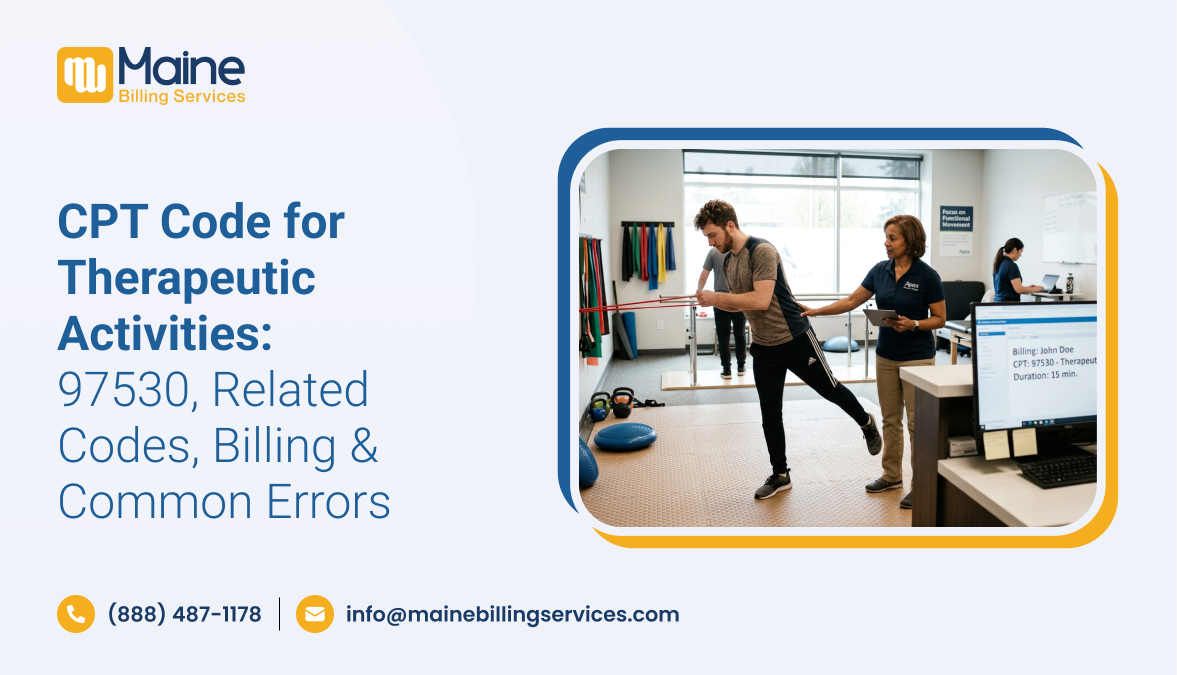
Therapeutic activities help patients regain functional movement and improve their ability to perform daily tasks after injury, illness, surgery, or other conditions affecting mobility. For physical and occupational therapy providers, however, delivering the treatment is only part of the process. The service must also be documented, coded, and billed correctly.
The primary CPT code for therapy services is 97530. This code is for direct, one-on-one patient contact with dynamic exercises to improve functional performance. Report in 15-minute units.
That’s more than just picking 97530 on a claim for charging therapeutic activities. Providers need to be able to demonstrate the skill involved in the service, associate the activity to an established functional goal, record the treatment time and adhere to the billing rules of the payer being billed.
Coding for other therapy codes that qualify by code (i.e., 97110, 97112, 97116, 97140, 97535, 97542) can be billed with that code. Education regarding equality in therapy can assist in reducing off-cardinal coding decisions, unsupported units and unexplained denial issues.
What Is the CPT Code for Therapeutic Activities?
The activity should have a documented functional purpose. The therapist’s skilled selection, adjustment, progression, and patient response should be supported in the treatment record.
The major code used for therapeutic activities is CPT 97530. CMS defines it as therapeutic activities that involve direct, one-on-one patient interaction and active activities to improve functional performance, reported for each 15 minutes.
Therapeutic activities may involve functional movements such as:
- Bending
- Lifting
- Carrying
- Reaching
- Catching
- Pushing
- Pulling
- Grasping
- Transfers
- Bed mobility
- Overhead activities
- Other goal-directed functional tasks
It’s not only about keeping the patient moving. The activity must be related to a documented functional impairment and involve the skill of the therapist to select, adjust, and progress the intervention.
CMS advice specifies therapeutic activities as dynamic functional exercises that may address impairments in mobility, strength, balance or coordination and should relate to a defined outcome.
So for 97530 coding, it has to be what the therapist actually did, and why the intervention was needed for the patient’s functional goals.
What Does CPT 97530 Include?
Typically, CPT 97530 is reported when the therapist does functional exercises to improve the patient’s ability to perform purposeful motions or tasks.
For example, if a patient has difficulty standing up from a chair, the therapist may use frequent sit-to-stand transfers as a therapy. Another patient may do reaching and lifting tasks to facilitate the functional use of the upper extremity. For example, a patient with balance impairment can perform functional motions of increasing difficulty around a documented treatment goal.
The crucial thing is the functional purpose of the action.
Saying “therapeutic activity performed” does not provide enough detail to convey what was done. The therapy note should include a description of the activity, the patient’s limitation, the help or cueing offered and the desired functional outcome.
This distinction is particularly crucial when 97530 is billed with other therapeutic procedure codes.
Related CPT Codes Used with Therapeutic Activities
Therapeutic activities may be part of a broader treatment plan. Depending on the services performed, other CPT codes may be appropriate.
| CPT Code | General Service | Primary Focus |
| 97530 | Therapeutic activities | Functional performance through dynamic activities |
| 97110 | Therapeutic exercises | Strength, endurance, flexibility, and range of motion |
| 97112 | Neuromuscular reeducation | Movement, balance, coordination, posture, and proprioception |
| 97116 | Gait training | Walking and gait-related training |
| 97140 | Manual therapy | Qualifying hands-on manual techniques |
| 97535 | Self-care/home management training | Training related to daily living and home management |
| 97542 | Wheelchair management | Wheelchair-related management and training |
Code selection should reflect the actual service performed and the documented therapeutic purpose. When multiple timed services are reported, the documentation should distinguish the interventions and support the applicable billing methodology.
CMS lists these as different therapeutic intervention codes and emphasizes that documentation should support each procedure in relation to a specific therapeutic goal.
CPT 97530 vs. 97110
CPT 97110 Therapeutic exercises to strengthen and endurance and range of motion and flexibility CPT 97530, on the other hand, refers to activities that are functionally dynamic in order to increase function.
For instance, a patient-specific transfer or lift activity may be billed with CPT 97530, a CPT that also includes the action of the activity’s strength (such as sit-to-stand transfer), as well as the exercise.
If billing for both services is to be done, the documentation should specify the two distinctly.
CPT 97530 vs. 97112
CPT 97112 is a neuromuscular reeducation code for movement, balance, coordination, posture and proprioception. If billing both 97112 and 97530, the treatment note should describe the different interventions and aims, not both services generically as “functional training.”
CPT 97530 vs. 97140
CPT 97140 specifies qualifying manual treatment procedures. The intervention is a manual, hands-on treatment, rather than a dynamic exercise to enhance functional performance, as in functional therapy activities.
When both services are provided during the treatment session, the paperwork and time records should support both.
CPT 97530 Billing Guidelines
One of the most critical aspects of 97530 billing requirements is accurate time reporting.
CPT 97530 is a timed service billed in 15-minute intervals. Treatment services billed in 15-minute units should contain the appropriate number of units, based on the timed-code requirements applicable to the service, CMS said.
Medicare outpatient therapy: For timed disciplines, providers determine the number of payable units based on the total timed treatment minutes. Therefore, the billing department should not bill one unit for each timed CPT code on the claim.
For example, consider a treatment session that includes:
- 20 minutes of therapeutic exercise — 97110
- 15 minutes of therapeutic activities — 97530
Total timed treatment time is 35 minutes. The total timed minutes are used per CMS guidance to determine the number of units and then the appropriate allocation mechanism is used across the services.
Commercial payers may have different policies, thus providers should check the criteria of the respective payer.
97530 Units and the 8-Minute Rule
The 97530 8-minute rule is an important consideration for Medicare therapy billing.
For applicable Medicare timed services, providers generally need at least 8 minutes of service to support one unit when the relevant conditions are met. When providers perform multiple timed services during the same session, they consider the total timed minutes and remaining minutes when allocating units.
CMS provides guidance on CMS Therapy Services, including timed-code billing and the Medicare 8-minute rule.
CMS provides an example involving 25 minutes of 97110 and 8 minutes of 97530. The combined timed treatment time is 33 minutes, which supports two timed units under the Medicare methodology. CMS then allocates those units based on the documented minutes for each service.
This means therapists and billing staff should document actual treatment time rather than estimating units after the visit.
Documentation Requirements for CPT 97530
The main things to document in the strength 97530 CPT code documentation include that it was skill dependent, medically necessary and targeted toward a functional result.
A treatment note should generally identify:
- The patient’s functional limitation
- The therapeutic activity performed
- The body movement or function being addressed
- The level of assistance or cueing required
- The therapist’s skilled involvement
- Treatment duration
- Patient response
- Progress toward the treatment goal
- Any modification or progression of the activity
Providers can also review the CMS outpatient rehabilitation therapy documentation requirements for additional guidance on documenting timed therapy services and supporting billed codes.
CMS expressly lists objective measurements linked to activities of daily living, balance, strength, coordination, range of motion, mobility, and functional impacts as supported documentation for 97530. Also exercises, amount and type of support are included to show the skill of the therapist.
A note saying only “97530 performed for 15 minutes” does not explain the clinical reasoning behind the service.
For more information about documentation and its relationship to revenue cycle processes, providers can review Maine Billing Services’ clinical documentation guide.
RESPONSE
GOAL
“97530 performed for 15 minutes” does not explain the functional activity, clinical purpose, skilled involvement, or patient response. The treatment record should provide enough detail to support the service and units billed.
Medical Necessity for Therapeutic Activities
The therapeutic action should be related to the patient’s reported disability and treatment goals and the medical requirement.
For example, a patient with weakness in the lower extremities and balance problems may have trouble with transfers. Therefore, the therapist can incorporate graduated transfer activities in the therapy plan. Documentation should include patient limitation, activity selected, skilled intervention and patient’s response.
The same activity may not be suitable for all patients. Treatment should therefore be customized and not reported with the same generic wording in many interactions.
This is also why accurate medical coding services should be based on the clinical record. The code should describe the service actually performed rather than simply reflect the diagnosis or general type of therapy visit.
Common CPT 97530 Billing Errors
Several issues can create problems with therapeutic activities billing.
Using 97530 for General Exercise
Not all exercise is a therapeutic activity. If the service is predominantly exercises to increase strength, endurance, flexibility or range of motion and the conditions of 97110 are met, 97110 may be more applicable.
Insufficient Functional Detail
Documentation should explain what functional activity was performed and what limitation it addressed. Generic statements make it difficult to establish medical necessity.
Unsupported Units
The number of units reported should correspond to documented treatment time under the applicable payer methodology.
Double-Counting Treatment Time
No single treatment time shall be used for more than one timed procedure. Treatment note must document the time spent on each intervention.
Reporting Multiple Codes Without Distinguishing Services
But if you’re submitting 97530 with 97110, 97112 or some other timed therapy, the documentation needs to explain what you did and why.
Ignoring Payer Requirements
Coverage, prior authorization, documentation, modifiers and unit calculation may vary for Medicare and private payers. When developing a billing workflow, the payer must be taken into account and one rule not applied across the board to all claims.
Modifiers and CPT 97530
Report modifiers only when the circumstances support their use and meet the payer’s requirements.
Providers may use modifiers such as GP and GO to identify services performed under a physical or occupational therapy plan of care. They may also use CQ and CO for qualifying services performed by physical therapist assistants or occupational therapy assistants. CMS said the CQ/CO standards and the de minimis policy that applies affect reporting of some services.
Therefore, modifier selection must be dependent on provider, service, plan of care, and payer rules.
A billing team should review the claim instead of automatically adding modifiers to each 97530 service.
How Accurate 97530 Coding Supports Reimbursement
Correct 97530 reimbursement is not just CPT code. All of the itemized payer contracts, coverage, authorization, medical necessity, paper work, provider enrollment and submitter accuracy that can impact payment.
A consistent billing workflow can help identify problems before and after claim submission.
This may include:
- Reviewing patient eligibility
- Confirming authorization requirements
- Reviewing documentation
- Selecting the appropriate CPT and ICD-10-CM codes
- Entering charges accurately
- Scrubbing and submitting the claim
- Monitoring claim status
- Posting payments and adjustments
- Following up on unpaid claims
- Managing denials and appeals
For practices that need additional front-end support, Maine Billing Services can provide insurance eligibility verification services for eligibility and authorization needs.
When Should Physical Therapy Practices Outsource Billing?
Complications may arise when the same staff handle registration, eligibility, coding, claim submission, payment posting, and rejection follow-up for these therapy claims.
Outsourcing is an option for practices seeking for physical therapy billing services when billing tasks are taking time away from administrative or clinical concerns.
A billing partner can support areas such as:
- CPT and ICD-10-CM coding
- Charge entry
- Claim submission
- Insurance verification
- Authorization tracking
- Denial management
- Payment posting
- A/R follow-up
- Payer communication
- Revenue cycle reporting
Maine Billing Services says its medical billing system comprises charge entry and code review, claim submission and scrubbing, payment posting, A/R and rejection follow-up and reporting.
Medical billing services in Maine are an option for practices to consider when seeking outsourced billing support.
Why Specialty-Focused Billing Matters
Therapy claims can involve multiple timed procedure codes, documentation requirements, payer policies, and authorization considerations. A general billing workflow may need additional attention when a practice has a high volume of rehabilitation services.
According to Maine Billing Services, the practice has experience with many specialties, including: orthopedic, chiropractic, and more.
Specialty-specific protocols can help billing teams comprehend the path from clinical documentation to CPT coding and claim submission.
For practices that also provide podiatric rehabilitation or related services, Maine Billing Services’ podiatry billing services provides another relevant internal-link opportunity.
Final Takeaway
Although 97530 is the basic CPT for therapeutic activities, billing is more than the wrong code.
Therapeutic activities will be noted apart from the exercises, neuromuscular re-education, manual therapy, gait training and self-care by the therapist. Record the activities that actually have a therapeutic value and record the specific functional impairment, activity, professional assistance, length of time, patient response, and therapeutic goal.
97530 is a timed code, billed in units of 15 minutes for Medicare therapy billing. Calculate units based on the proper timed code practice. CMS guidance emphasizes that the medical record must support the CPT codes and units reported.
Although this stage of the revenue cycle supports denial management, patient accounting, and collections, it also affects how staff record charges, submit claims, post payments, and follow up on rejections.
If your clinics are in the process of outsourcing their physical therapy billing, a claim based billing process that records timed services will be the icing on the cake for your clinical data.
Frequently Asked Questions About CPT Code for Therapeutic Activities
What is the CPT code for therapeutic activities?
The primary CPT code is 97530. It describes therapeutic activities involving direct, one-on-one patient contact and dynamic activities designed to improve functional performance, reported in 15-minute units.
What is CPT 97530 used for?
CPT 97530 is used for qualifying dynamic therapeutic activities intended to improve functional performance. Examples can include functional reaching, lifting, transfers, bed mobility, and other goal-directed activities when supported by the clinical record.
Is CPT 97530 a timed code?
Yes. CPT 97530 is reported in 15-minute units. Applicable Medicare therapy claims use the timed-code methodology to determine the number of units supported by the documented treatment time.
Can 97530 and 97110 be billed together?
If providers perform distinct services independently and support them with clinical documentation, they may report the services together when appropriate. The treatment note should distinguish the therapeutic activity from the therapeutic exercise and mark the time and purpose of each service.
Does the 8-minute rule apply to 97530?
For applicable Medicare outpatient therapy billing, 97530 is subject to the Medicare timed-service methodology. The total timed treatment minutes and the time spent on each service determine the reportable units.
What documentation supports 97530?
Findings should include type of activity, type of skill, type of skilled care, assistance or cueing, treatment time, and patient response, and, when relevant, link to the treatment plan, activity, activity amount, functional goals, and time of skilled care. (CMS specifically asks for “quantitative or objective” data on activity and assistance.
Can physical therapy practices outsource 97530 billing?
Yes. Practices can outsource broader physical therapy billing services, including coding, charge entry, claim submission, payment posting, denial management, and A/R follow-up. The billing workflow should still be based on the provider’s documentation and the applicable payer requirements.