

A wound care ICD-10 code is a diagnosis code used to show the type, location, and severity of a wound for billing and reimbursement. It replaced ICD-9 in 2015. These codes clarify what the Medicare and other payers are being treated for.
A universal wound care code does not exist. The correct code is dependent upon:
- The type of wound
- The location and laterality
- The degree or depth of tissue changes
- If the wound is healing normally or not
Vague coding is one of the common reasons for denial of claims. More precise and accurate coding ensures prompt and accurate payment.
What Are the Most Common ICD-10 Codes for Wound Care?
The most common codes are from:
- Z48 – aftercare
- T81 – surgical complications
- L97 – chronic ulcers
Z48 Series – Routine Wound Care Encounters
| Code | What It Documents |
| Z48.00 | Nonsurgical wound dressing change or removal |
| Z48.01 | Surgical wound dressing change or removal |
| Z48.02 | Removal of sutures or staples |
| Z48.1 | Planned postprocedural wound closure |
- Z48.00: It covers non-surgically created wounds, burns, and pressure ulcers.
- Z48.01: It applies to post-surgical wounds healing.
- Z48.02: It is used when sutures or staples are removed.
Always pair Z48 codes with the underlying condition code.
What Is the ICD-10 Code for Wound Care Unspecified?
The code for an unspecified wound care visit is Z48.00. It is used for encounters for change or removal of a nonsurgical wound dressing. It is often used when documentation does not clearly describe the wound details.
However, using unspecified codes repeatedly creates audit risk. The OIG data shows over $100 million in improper wound care payments in recent years.
If documentation is incomplete, query the provider before submitting. Request:
- Wound location
- Wound depth
- Presence or absence of infection
- Surgical or non-surgical origin
Clean documentation leads to clean claims.
What Is the ICD-10 Code for a Non-Healing Surgical Wound?
Non-healing surgical wound codes are:
- T81.89XA
- T81.89XDr
Use these codes only when the clinical notes confirm:
- The wound is of surgical origin
- No signs of infection are present
- No wound dehiscence
For other surgical wound complications, the codes change:
| Scenario | Initial Encounter Code | Subsequent Encounter |
| Non-healing, no infection, no dehiscence | T81.89XA | T81.89XD |
| External wound dehiscence | T81.31XA | T81.31XD |
| Internal operative wound disruption | T81.32XA | T81.32XD |
| Wound disruption, unspecified | T81.30XA | T81.30XD |
| Infected surgical wound | T81.49XA | T81.49XD |
The 7th letter is required. If not, the code is not a Billable Code.
- A = First treatment for this complication
- D = Subsequent encounter
- S = Sequela
Using the wrong 7th character is a common, and costly mistakes.
What Is the ICD-10 Code for Wound Culture?
Wound Culture coding depends on the wound diagnosis and the lab results.
A wound culture usually requires two codes. One code is used for the primary wound diagnosis. The second code identifies the organism found in the culture.
When the culture is positive, use a B95–B97 code as a secondary code. These codes describe the bacteria or virus causing the infection. They are never used alone.
If there is abnormal wound secretion but no confirmed organism, use R89.5. It reports abnormal microbiological findings in tissue or specimen tests. This code became effective in FY 2026.
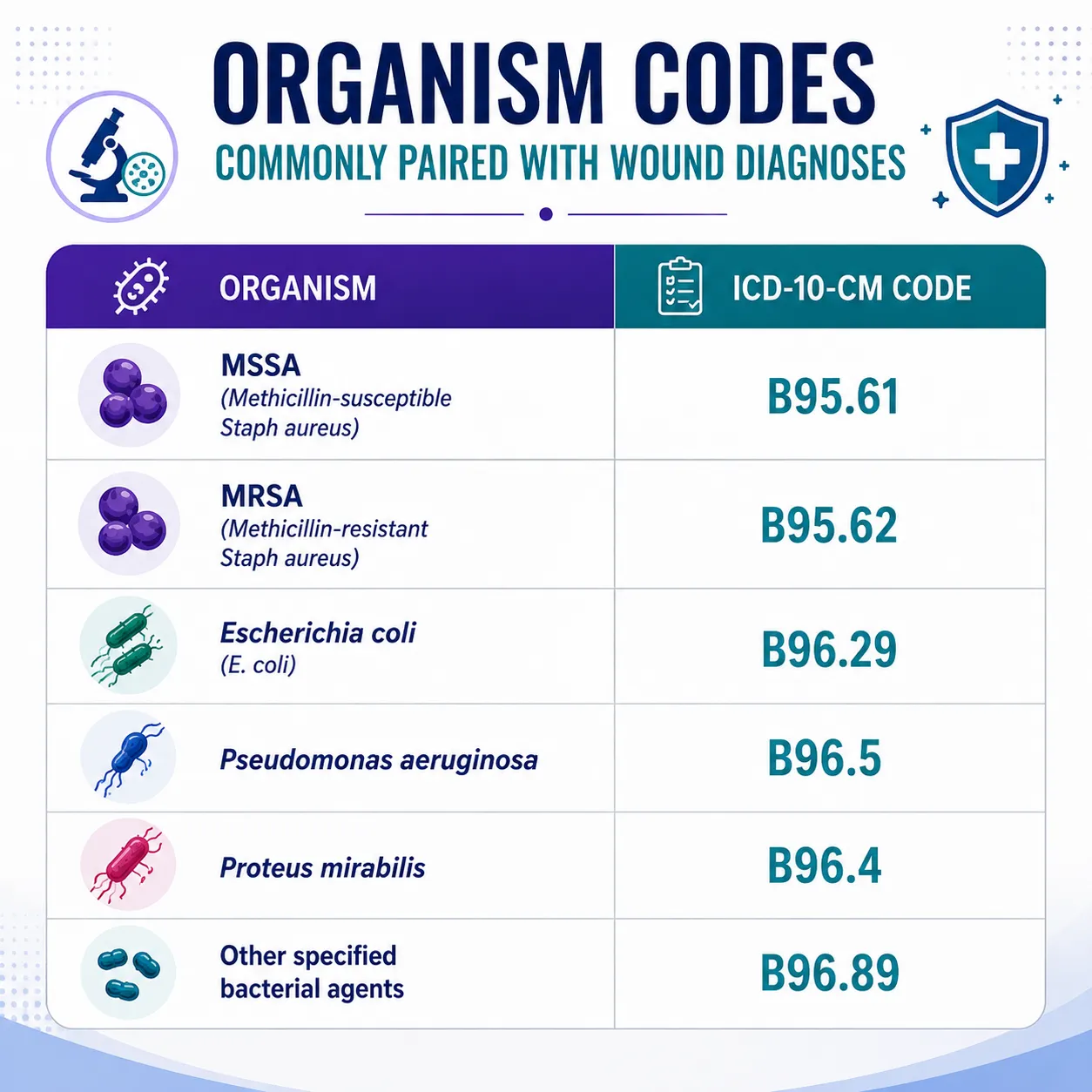
Correct pairing of diagnosis and organism codes supports medical necessity.
How Do ICD-10 Coding Guidelines Apply to Wound Care?
The ICD-10-CM Official Coding Guidelines have five rules:
- Code to the Highest Level of Specificity
- Use Aftercare Codes Only for Normal Healing
- Code All Relevant Conditions
- Match the 7th Character to the Encounter
- Documentation Must Support Every Code
What Are the ICD-10 Codes for Chronic Non-Healing Wounds?
L97 series ps used for coding chronic non-healing wounds. This is for the wounds that are not caused by surgery. It refers to non-pressure chronic ulcers of the lower limb.
L97 codes require four key clinical details:
- Body part
- Laterality
- Tissue depth
- Necrosis
Example L97 Code Breakdown
| Code | What It Documents |
| L97.311 | Right ankle ulcer, limited to skin breakdown |
| L97.321 | Right ankle ulcer, fat layer exposed |
| L97.521 | Left heel and midfoot ulcer, fat layer exposed |
| L97.909 | Non-pressure ulcer, unspecified lower limb, unspecified severity |
Missing depth in the documentation is a common reason L97 claims get denied.
What Are the Most Common Wound Care Coding Mistakes?
These seven errors that cause majority of wound care claim denials.
- Using Z48.00 instead of Z48.01: Z48.00 is used for non-surgical wounds. Z48.01 is for surgical wound dressing changes. Confusing the two can cause denial.
- Missing the 7th character on T81 codes: You can’t bill T81.89X without a 7th character. Always add A, D, or S.
- Using T81.89X- when dehiscence is present: T81.31XA is the code for Dehiscence. Using the wrong code leads to both denials and compliance risk.
- Skipping organism codes after a positive wound culture: Positive cultures require a B95–B97 secondary code. Omitting it leaves clinical information on the table.
- Coding vague diagnoses repeatedly: Multiple claims with Z48.00 and no supporting secondary codes attract OIG attention. Specificity protects your practice.
- Ignoring laterality in L97 codes: Right vs. left is not optional. If laterality is required but it’s absent, te claim will be rejected.
- Coding the procedure without the diagnosis: ICD-10 codes document the diagnosis. CPT codes document the procedure. Both are required on every claim.
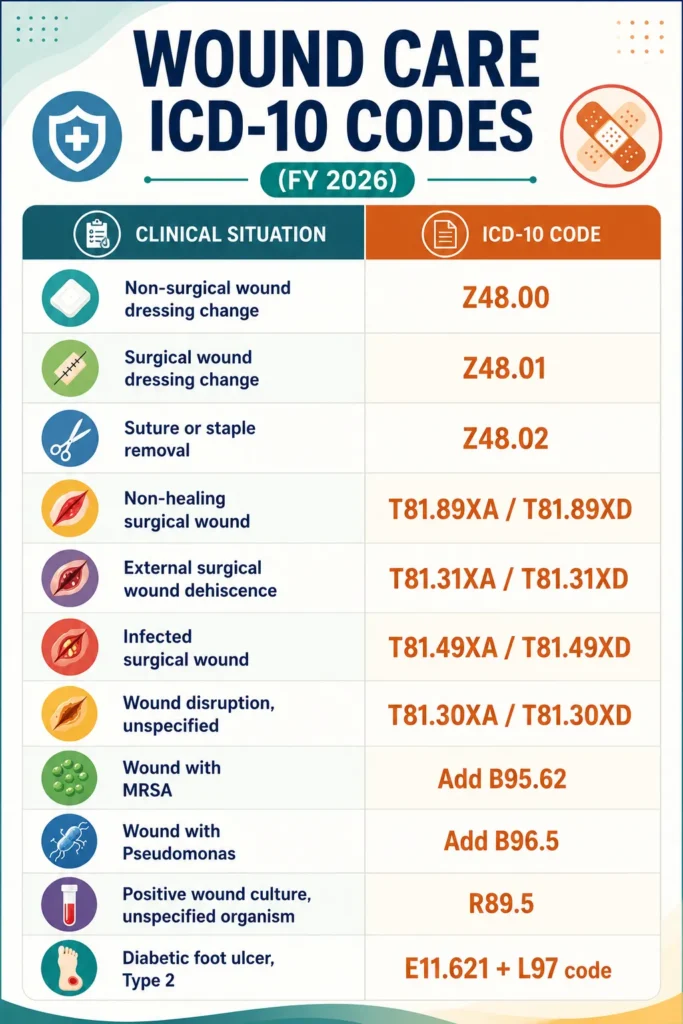
Get Expert Help With Wound Care ICD-10 Coding
Wound care ICD-10 coding directly affects audit exposure. Specific codes get claims paid. Vague codes invite denials. Missing characters make claims non-billable. Incorrect organism codes leave revenue uncaptured.
If your wound care claims are being denied, Maine Billing Services provides expert medical billing support. Our services are built around accuracy and compliance.
Contact us today for maximum reimbursement.
Frequently Asked Questions
1. What if wound documentation is incomplete?
Do not assume a code. Ask the provider for missing details like wound depth, location, or infection status before billing.
2. Are ICD-10 codes enough for wound billing?
No. ICD-10 codes describe diagnosis only. CPT codes are also required for procedures like debridement and wound care services.
3. Why does laterality matter in coding?
Laterality identifies the left or right side. Without it, payers may reject claims because the treatment site is not clearly defined.